The Gresford Disaster


The Gresford Disaster
Welcome to the interactive digital exhibition.
Explore the history of the 1934 Gresford Mining Disaster by clicking the buttons on the spinning Colliery wheel.
Acknowledgements
With special thanks to Karen Holmes, Michael Hett, Wendy Hett, Claire Harrington, and Sarah Castagnetti for their invaluable assistance.
Text: Wrexham Miners Project
Researcher & Designer: Dr Grace Thomas
The Disaster & Rescue
During the early morning of the 22nd of September 1934 between 480 and 500 men were underground at Gresford working the night shift. Many had agreed to undertake a double shift so that they could meet the quota of coal for the weekend. This meant that the numbers on shift were higher than usual, with the men split between the Dennis section and an area around 2 miles away known as the slant. At approximately 2 am a huge explosion shook the mine and started multiple fires which quickly spread.
"Something has happened down the Dennis. I think it has fired"
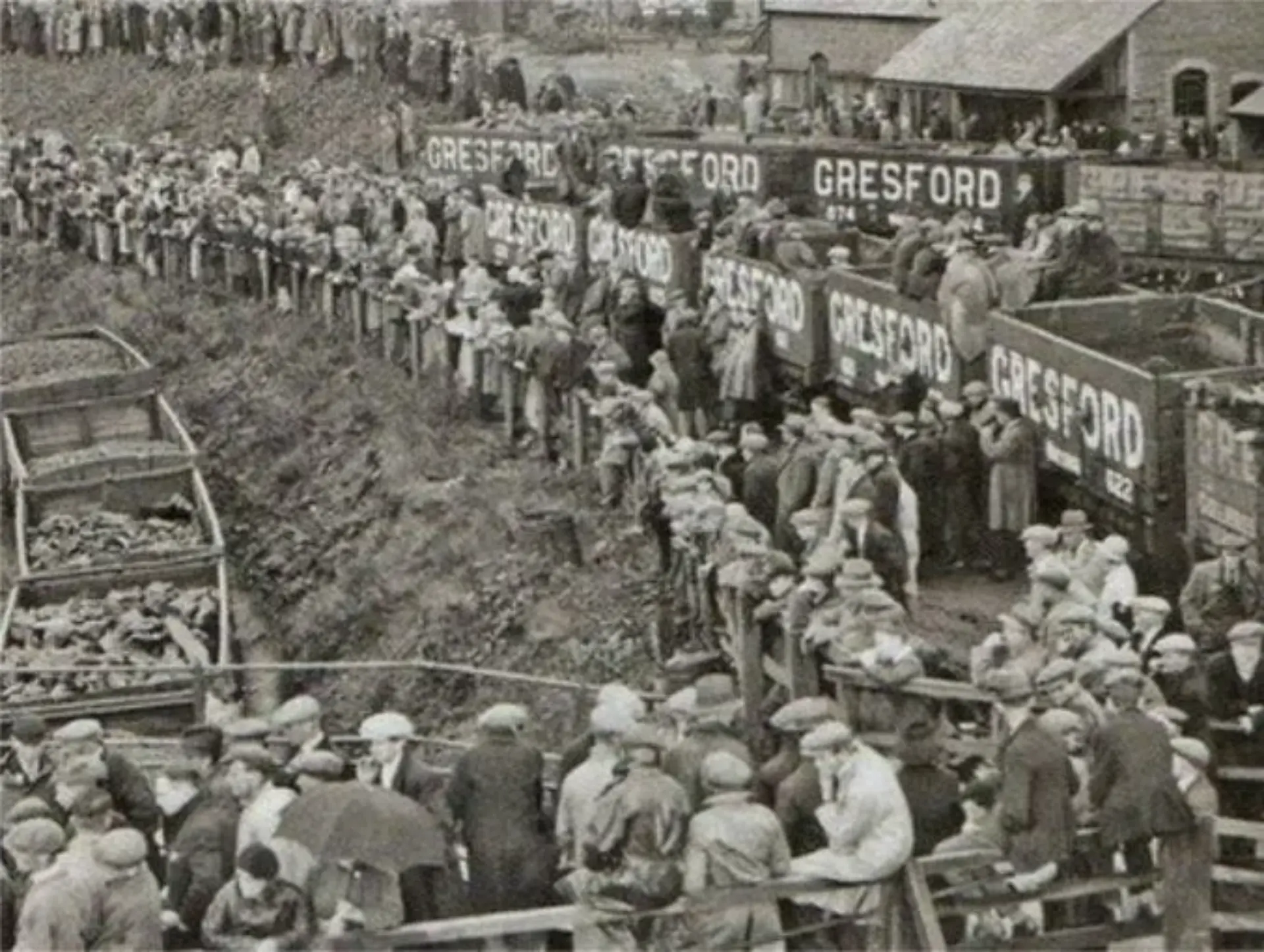 Anxious crowds gather at the pit head as news of the explosion spreads through the community. (Credit: Wrexham Miner’s Project; Click to enlarge)
Those miners in the Dennis section not killed by the first blast found themselves trapped and facing an unimaginably terrifying situation. The initial explosion and smaller blasts which followed caused many of the underground roadways connecting different areas to collapse, while fire blocked off those which remained, making escape or rescue impossible. In a short space of time 266 men and boys had been killed by the explosions, toxic gases, fire or falling debris. Only six men from the Dennis, taking a mid shift break in a relatively safe area escaped with their lives. As they left they encountered the dead and the dying.
"One fellow said: 'Wait until somebody comes for us.' But nobody was coming for us at all. It was the last time we saw them"
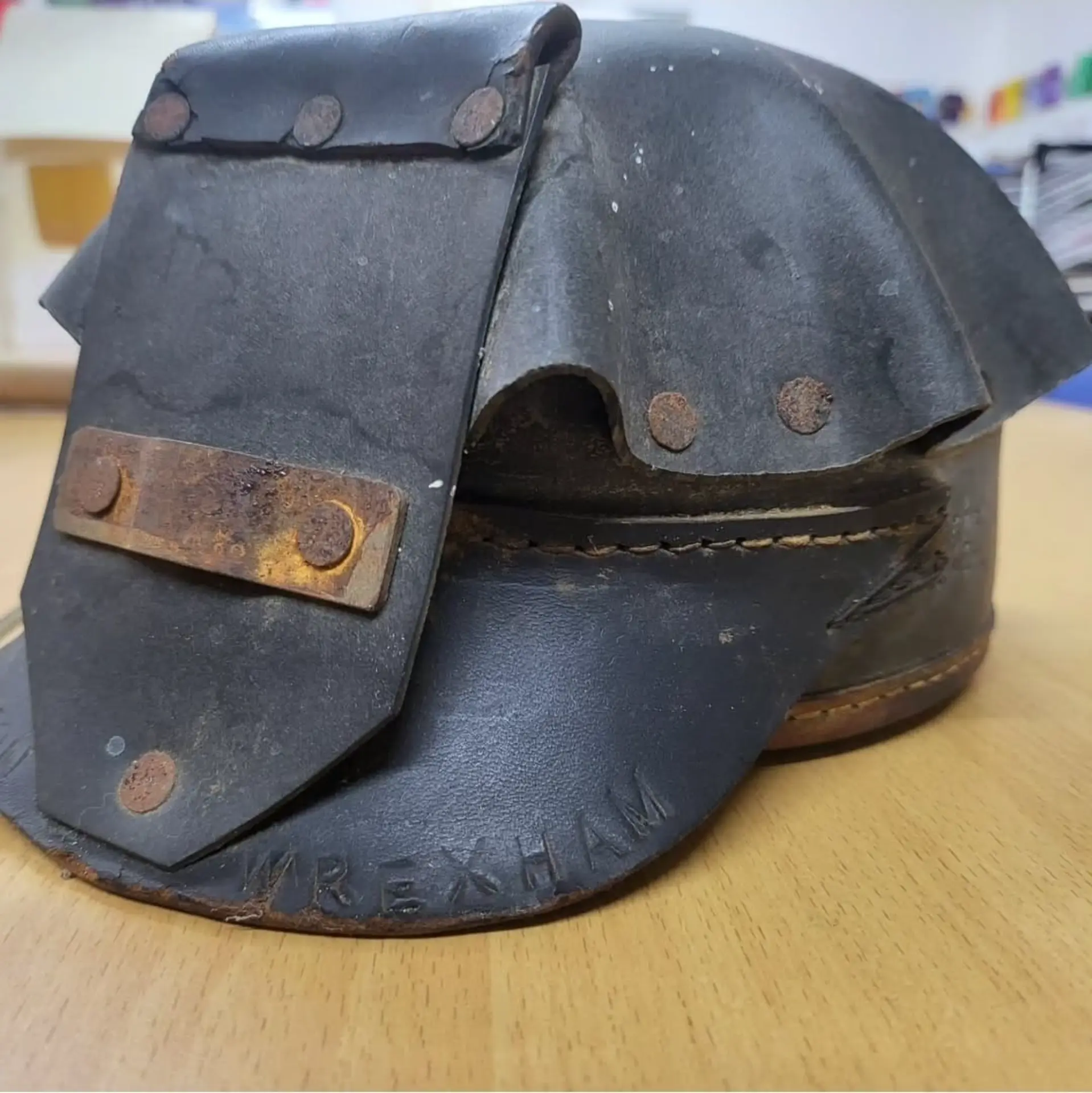 A leather rescue helmet of the type worn by the brave men who entered the burning mine. (Credit: Wrexham Miner’s Project; Click to enlarge)
By 5am a rescue team had arrived from nearby Llay Colliery to assist with the rescue. An optimistic assessment of the situation suggested that there was a chance large numbers of men were trapped alive, and that rescue was possible, however it is likely that by this time most men in affected areas were dead. One Llay rescue team led by John Charles Williams were instructed to assess the conditions of a potential rescue route. Despite their canary dying they pressed onwards and were overcome by toxic gas, killing three and leaving Edwards the only survivor.
"It is all Hell let loose..there is no chance of any man in that pit being left alive"
 Gresford Colliery Disaster, 22 September 1934, William Bonsall, right, colliery manager 1934.webp) The mine manager oversees the desperate rescue operations. (Credit: The National Archives; Click to enlarge)
The mine manager oversees the desperate rescue operations. (Credit: The National Archives; Click to enlarge)
 Gresford Colliery Disaster, 22 September 1934, rescue and recovery team training at Llay Main Colliery 1934-1935.webp) A rescue team prepares to descend into the Dennis section. (Credit: The National Archives; Click to enlarge)
A rescue team prepares to descend into the Dennis section. (Credit: The National Archives; Click to enlarge)
The Victims
The first accurate reports about the scale of the Gresford Disaster were published on the afternoon of the 22nd of September, by a young reporter named Geoff Charles. While other journalists quoted the management figure of 100 dead, Charles immediately made his way to the colliery lamp room where he hurriedly counted 260 lamps taken out. Though he was accused of exaggerating the death toll by other journalists, his figure published in the Wrexham Star proved to be shockingly accurate.
Life for the people of Wrexham was forever transformed by the Gresford Disaster. In a town of around 20,000 people, most knew one of the 266, while many families were left destitute by the loss of a bread winner. Funds raised by the Mayor of Wrexham, the High Sheriff of Denbighshire and Lord Mayor of London totalled £580,000, though in the long term this could not compensate for the loss of a regular wage.
"The owners have sent some white lilies to pay for the poor colliers' lives. Farewell, all our dear wives and our children. Farewell, all our comrades as well. Don't send your sons down the dark dreary mine. They'll be doomed like the sinners in hell."
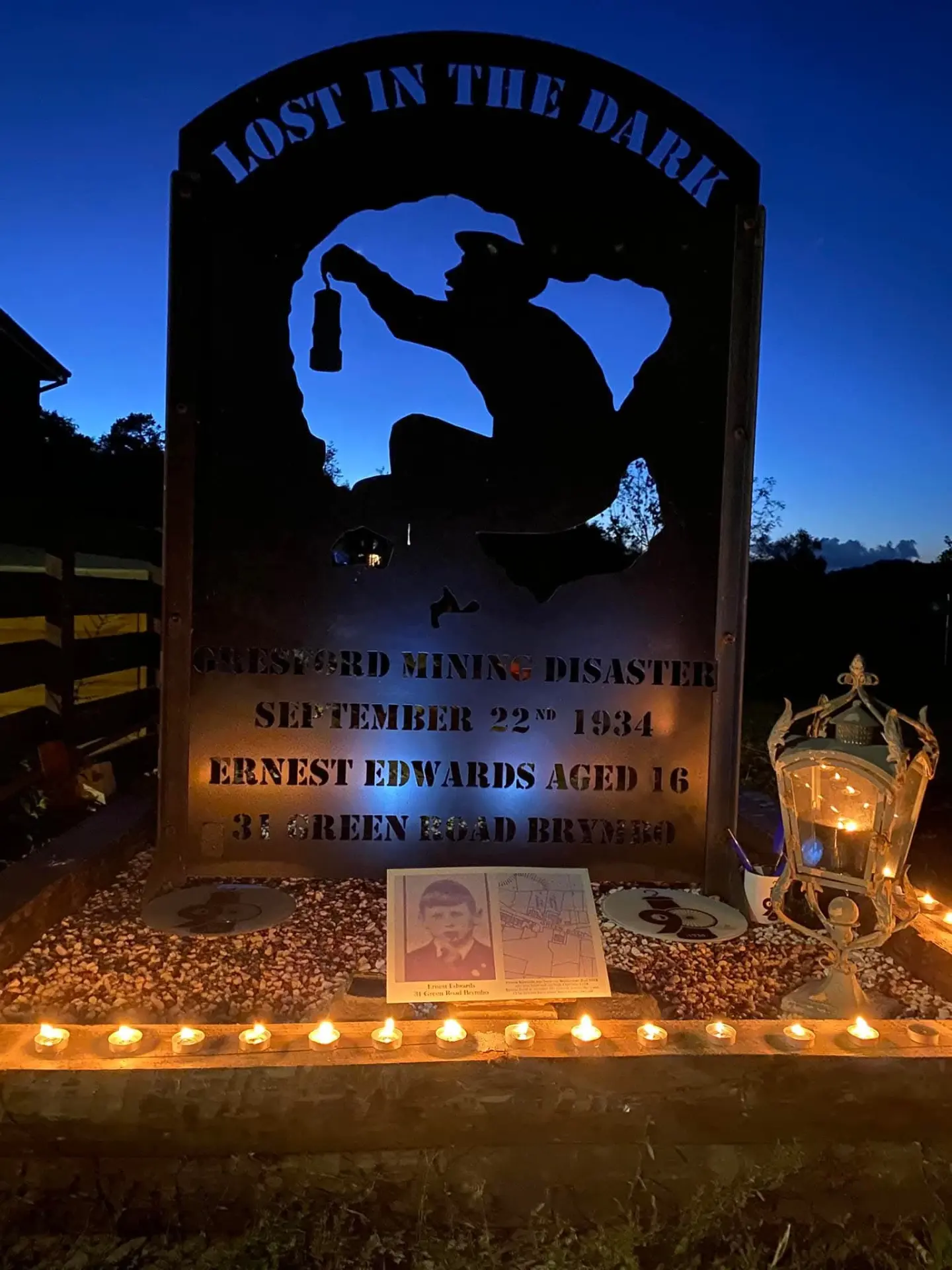 The memorial dedicated to Ernest Edwards, the youngest life claimed by the disaster. (Credit: Wrexham Miner’s Project; Click to enlarge)
In the weeks following the disaster, families grew desperate for the return of their loved ones. Margaret Capper wrote a heart-wrenching letter to Sir Henry Walker, the Chief Inspector of Mines, pleading for the recovery of her brother, John Capper. She explained that her request was driven by the deteriorating mental health of her parents, who could not bear the thought of their son lying in the mine.
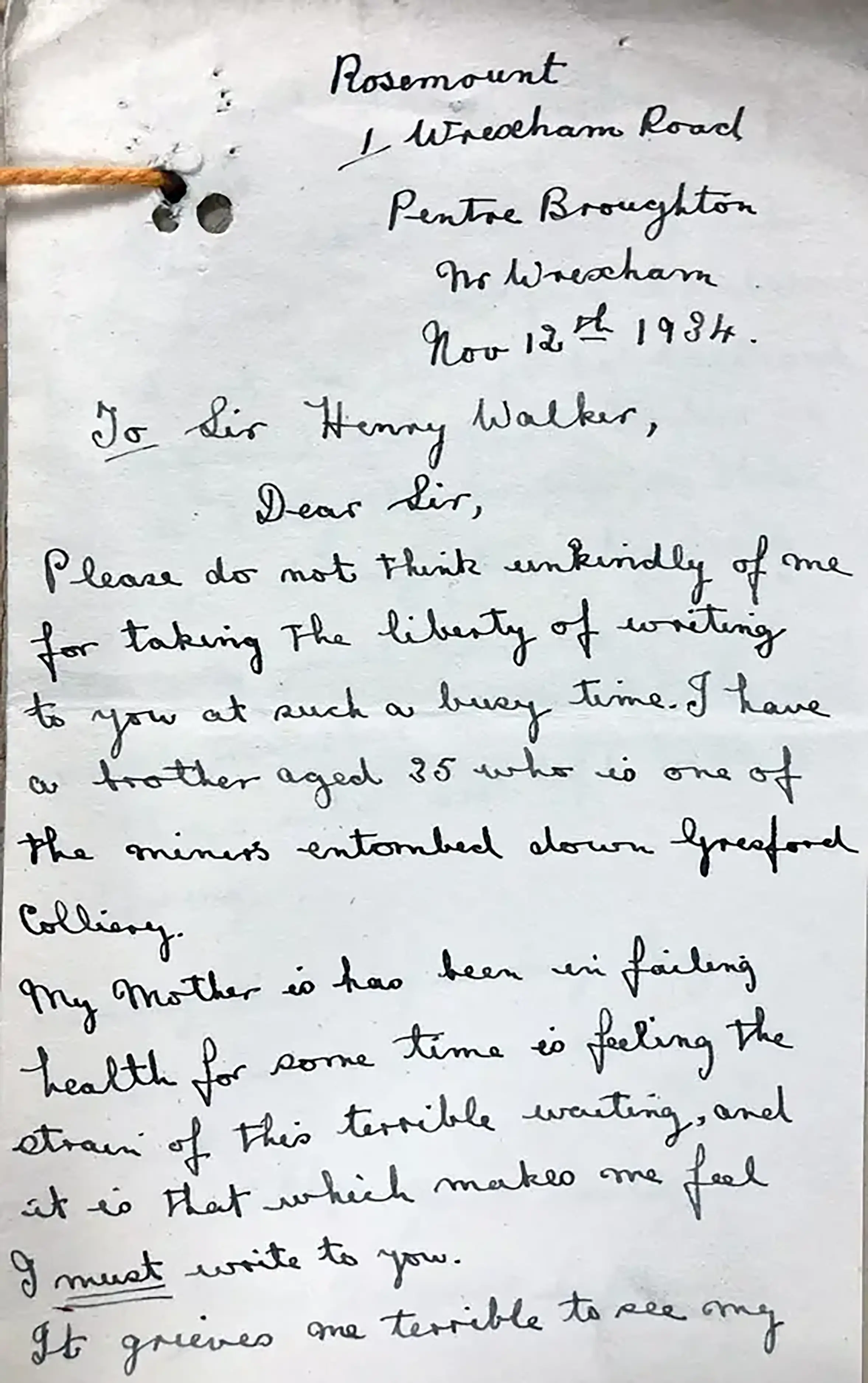 A letter from Margaret Capper seeking news of her brother. (Credit: The National Archives; Click to enlarge)
Read Transcript
My Mother [who] has been in failing health for some time is feeling the strain of this terrible waiting, and it is that which makes me feel I must write to you.
It grieves me terrible to see my Mother and Father suffering terrible under this heavy burden they have to bear, and the thought of where their loved one is lying is unbearable. Could not an attempt be hastened to try and get those bodies in their proper resting place, by doing this you will give the only consolation there is to be given to those who are left behind suffering."
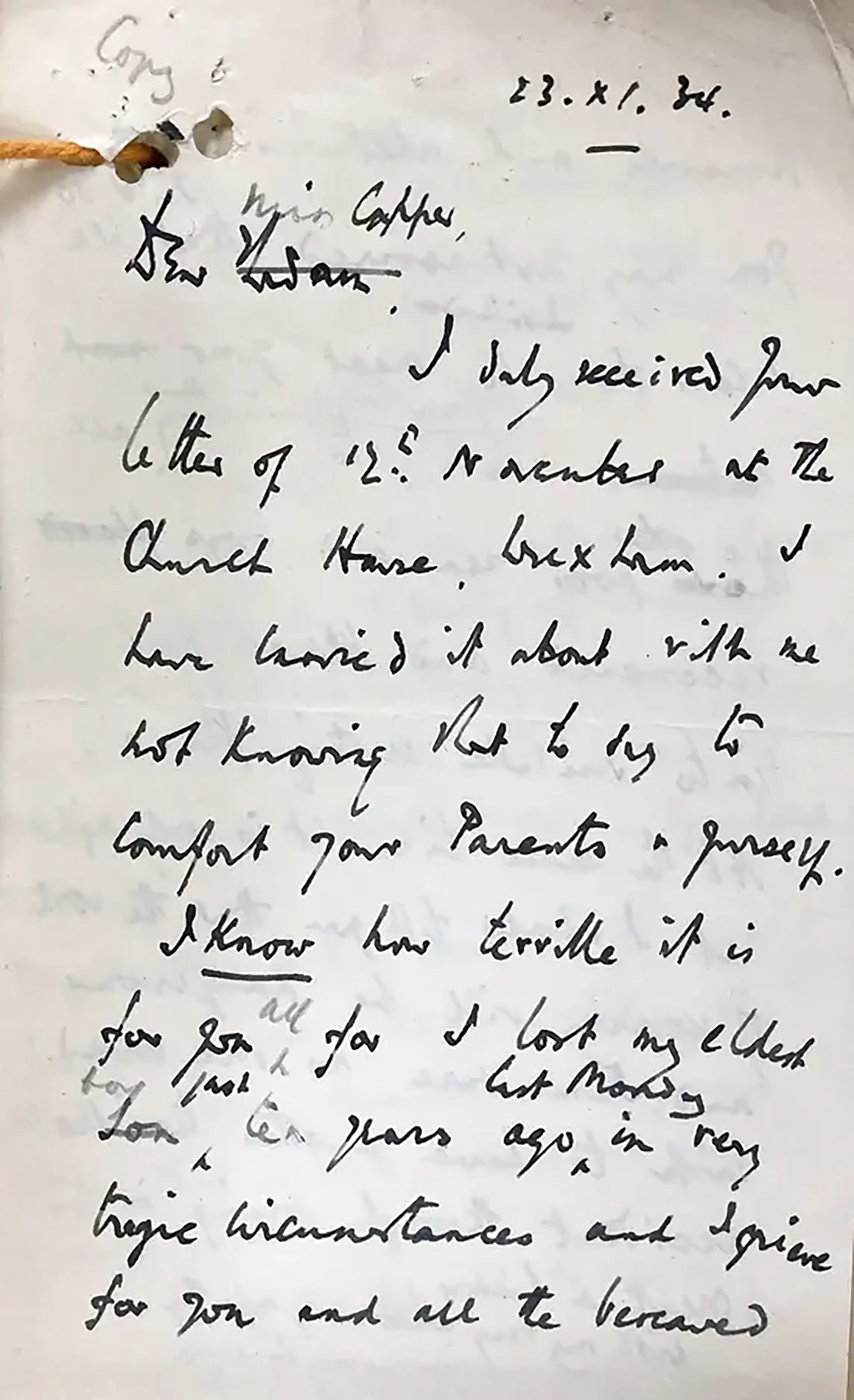 The reply from Sir Henry Walker, Chief Inspector of the Mines, declining Margaret Capper's request. (Credit: The National Archives; Click to enlarge)
Read Transcript
I know how terrible it is for you all for I lost my eldest boy just ten years ago last Monday in very tragic circumstances and I grieve for you and all the bereaved parents and relatives.
You may rest assured that I will do all I can to meet your wish to have your loved one and all the other poor men and boys recovered and put into a suitable resting place. At the same time it is only right that I should tell you that the work of recovery will be dangerous and I am sure no one would wish to have another terrible accident through being in too great a hurry.."
The Relief Effort
The public established the Wrexham Miner’s Relief Fund immediately to support the destitute families. Contributions poured in from every corner of society. Local groups mobilised quickly. The Women's Institute and children from schools like Pentre Mawr organised collections to gather supplies for their neighbours.
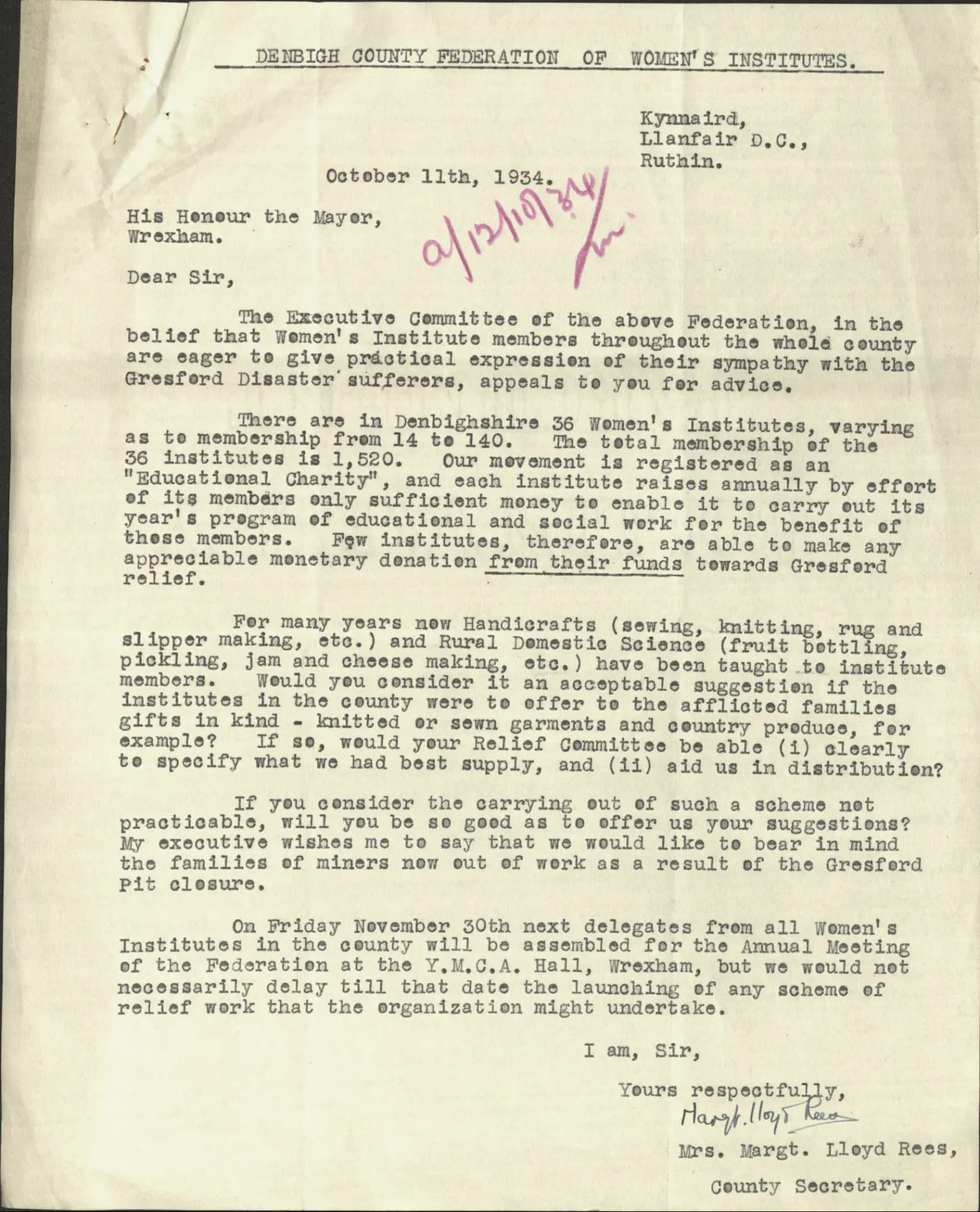 A letter showing the contribution from the Women's Institute. (Credit: North East Wales Archives; Click to enlarge)
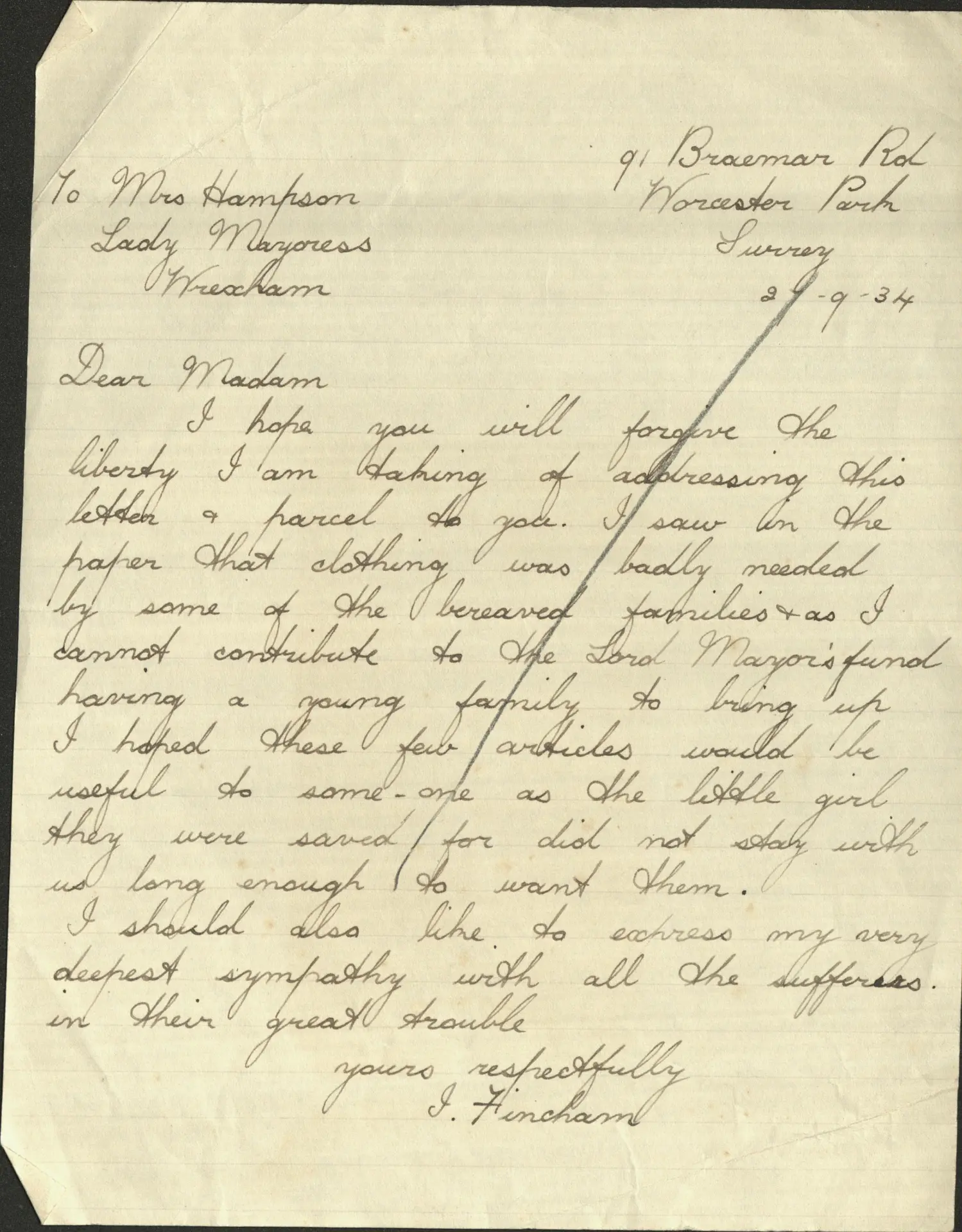 A letter from Mrs I Fincham accompanying a donation of children's clothes from a child that passed away. (Credit: North East Wales Archives; Click to enlarge)
Read Transcript
I hope you will forgive the liberty I am taking of addressing this letter and parcel to you. I saw in the paper that clothing was badly needed by some of the bereaved families and as I cannot contribute to the Lord Mayor’s fund having a young family to bring up I hoped these few articles would be useful to someone as the little girl they were saved for did not stay with us long enough to want them. I should also like to express my very deepest sympathy with all the sufferers in their great trouble. “
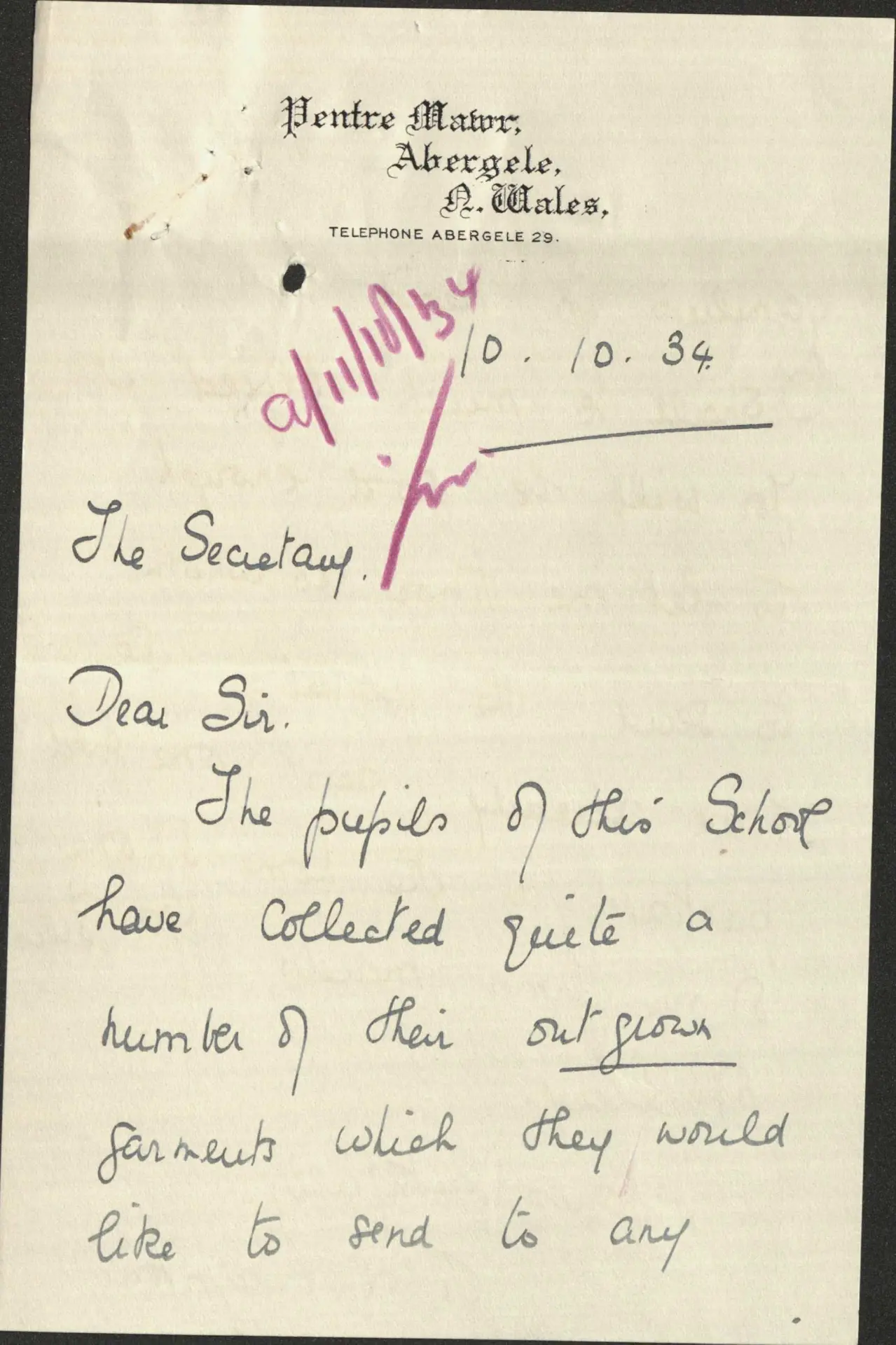
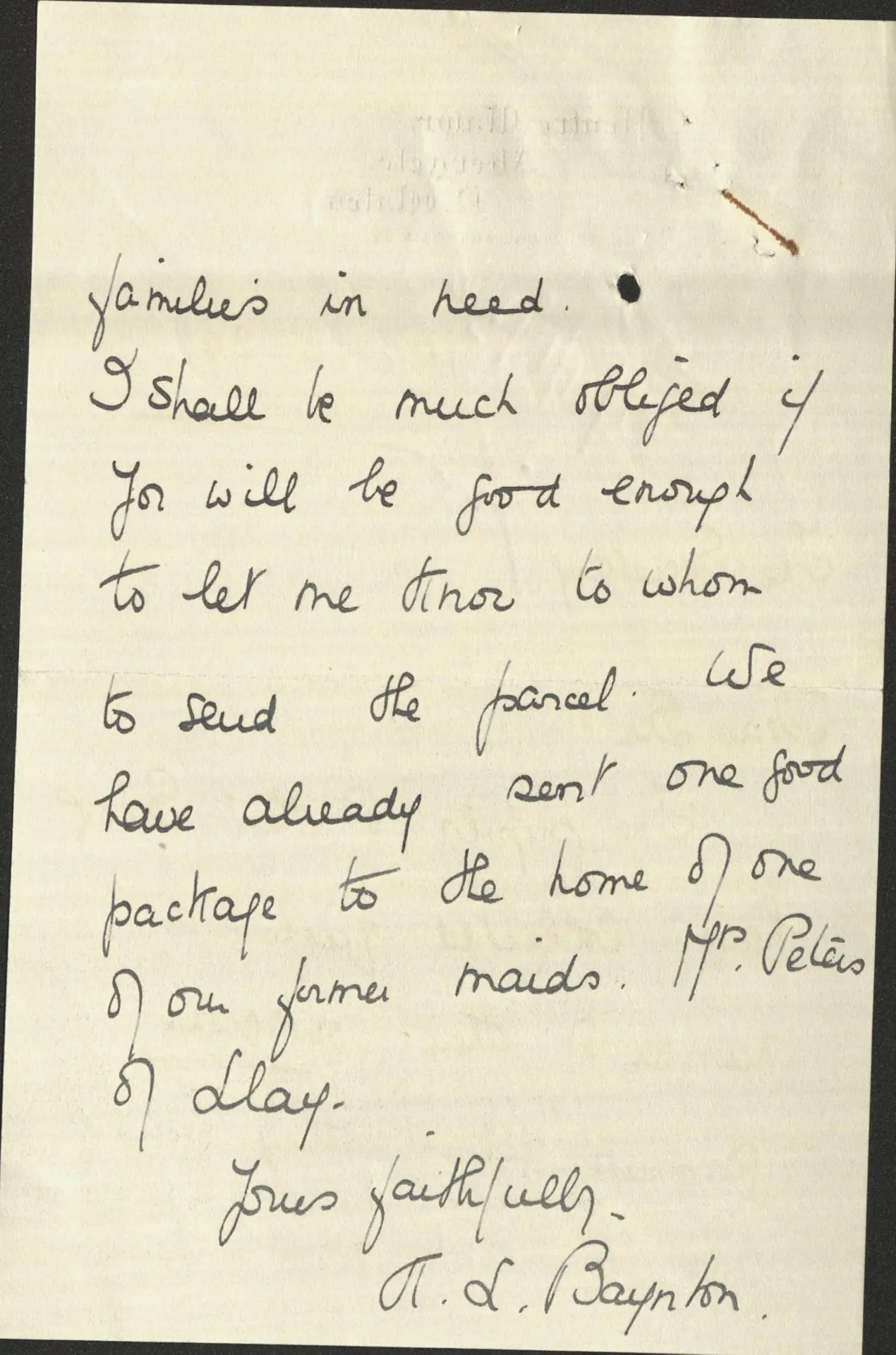
Read Transcript
The pupils of this school have collected quite a number of their outgrown garments which they would like to send to any families in need. I shall be much obliged if you will be good enough to let me know to whom to send the parcel. We have already sent on food package to the home of one of our former maids”
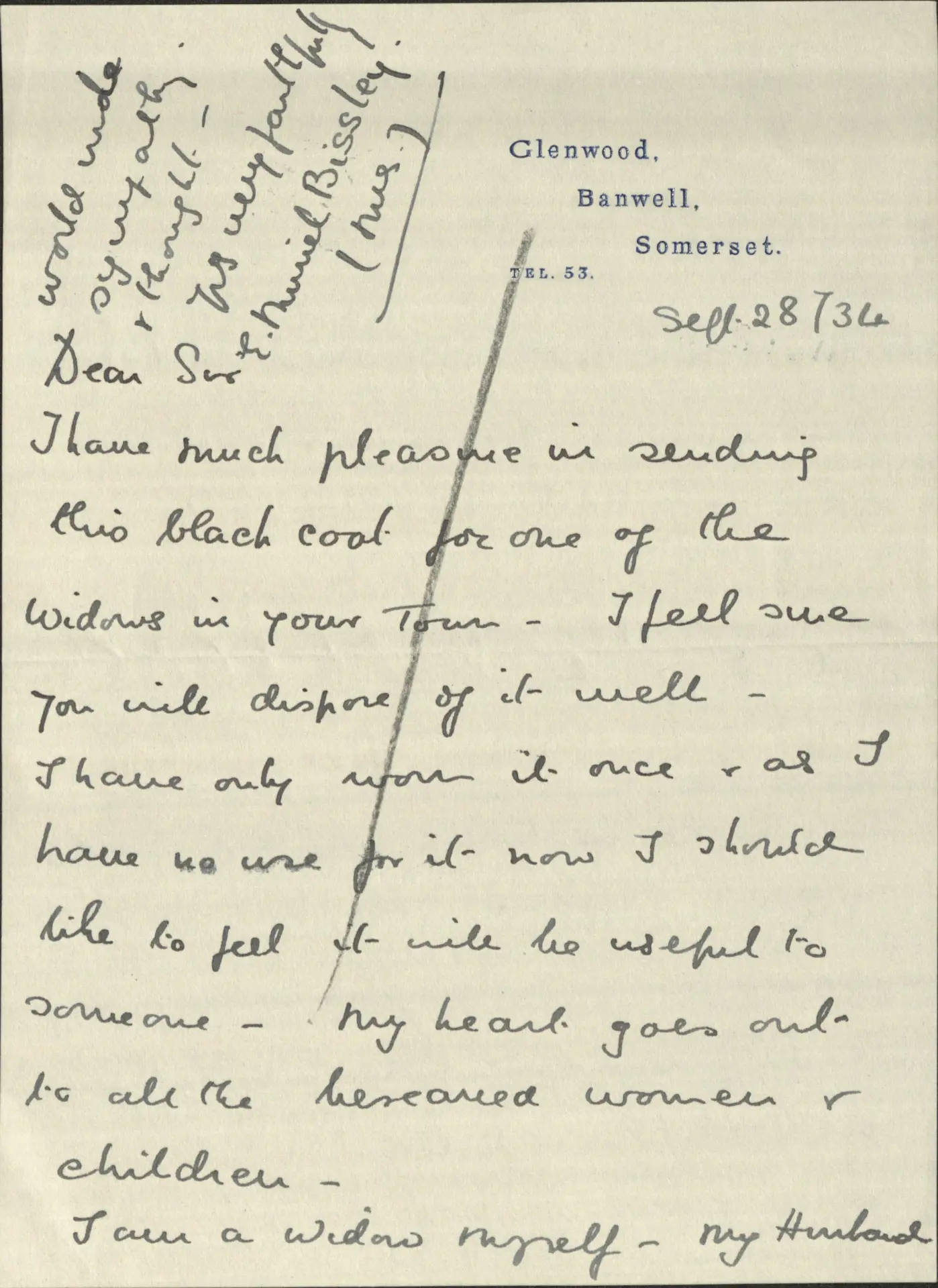
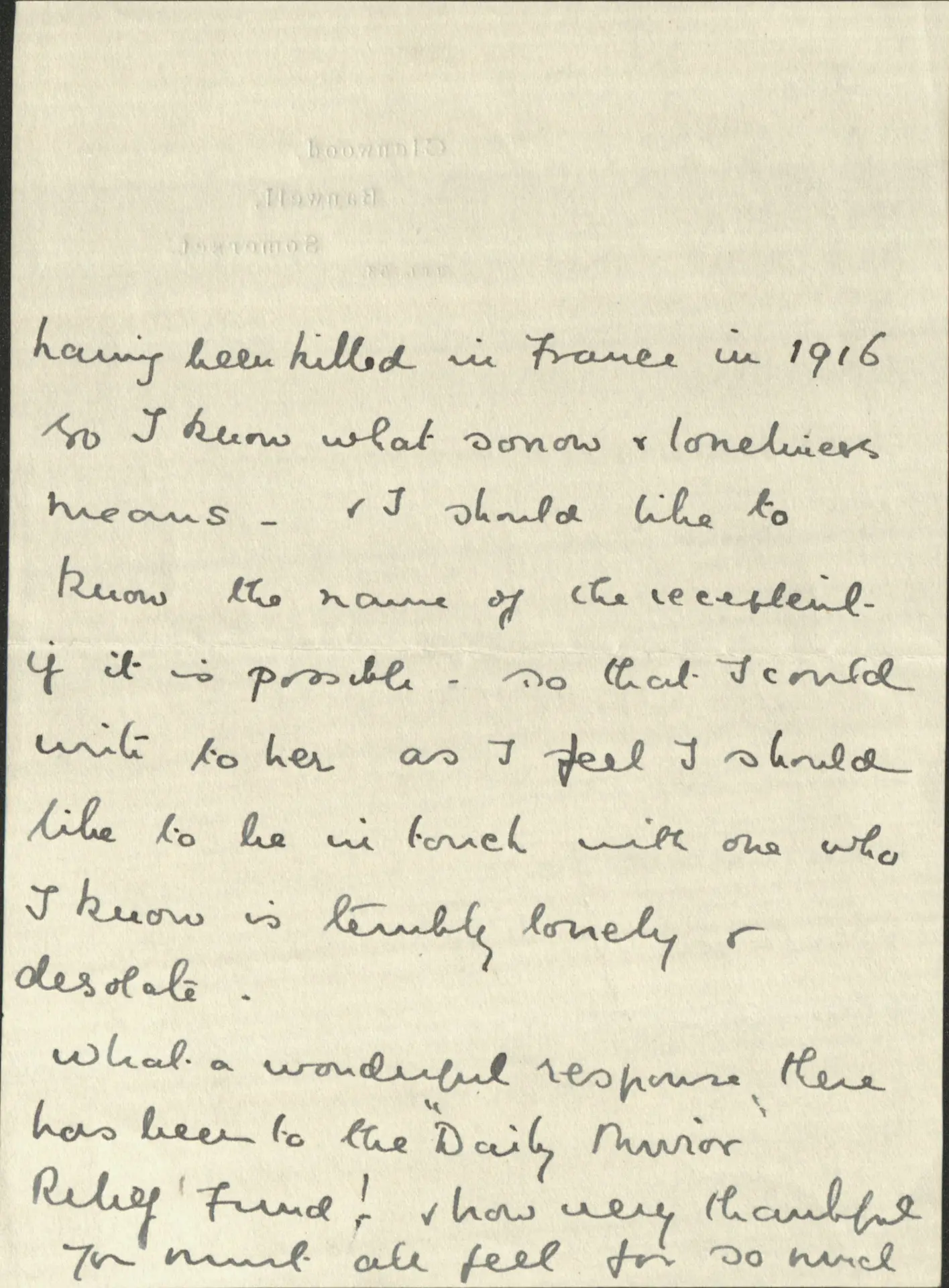
Donors sent essential clothing and footwear as winter approached. Records show donations of mended boots and children's clothes. A widow donated her own black coat to help another woman in mourning.
Read Transcript
I have much pleasure in sending this black coat for one of the widows in your town. I am sure you will dispose of it well. I have only worn it once and as I have no use for it now I should like to feel it will be useful for someone. My heart goes out to all the bereaved women and children. I am a widow myself – my husband having been killed in France in 1916. So I know what sorrow and loneliness means. I should like to know the name of the recipient if it is possible so that I could write to her as I feel I should like to be in touch with one who I know is terribly lonely and desolate. What a wonderful response there has been to the “Daily Mirror relief Fund”! and how very thankful you must all feel for so much –"
Food and other supplies arrived in large quantities to feed the grieving families. Archives list donations of soup, 1,000 tins of ham, and 100 boxes of kippers.
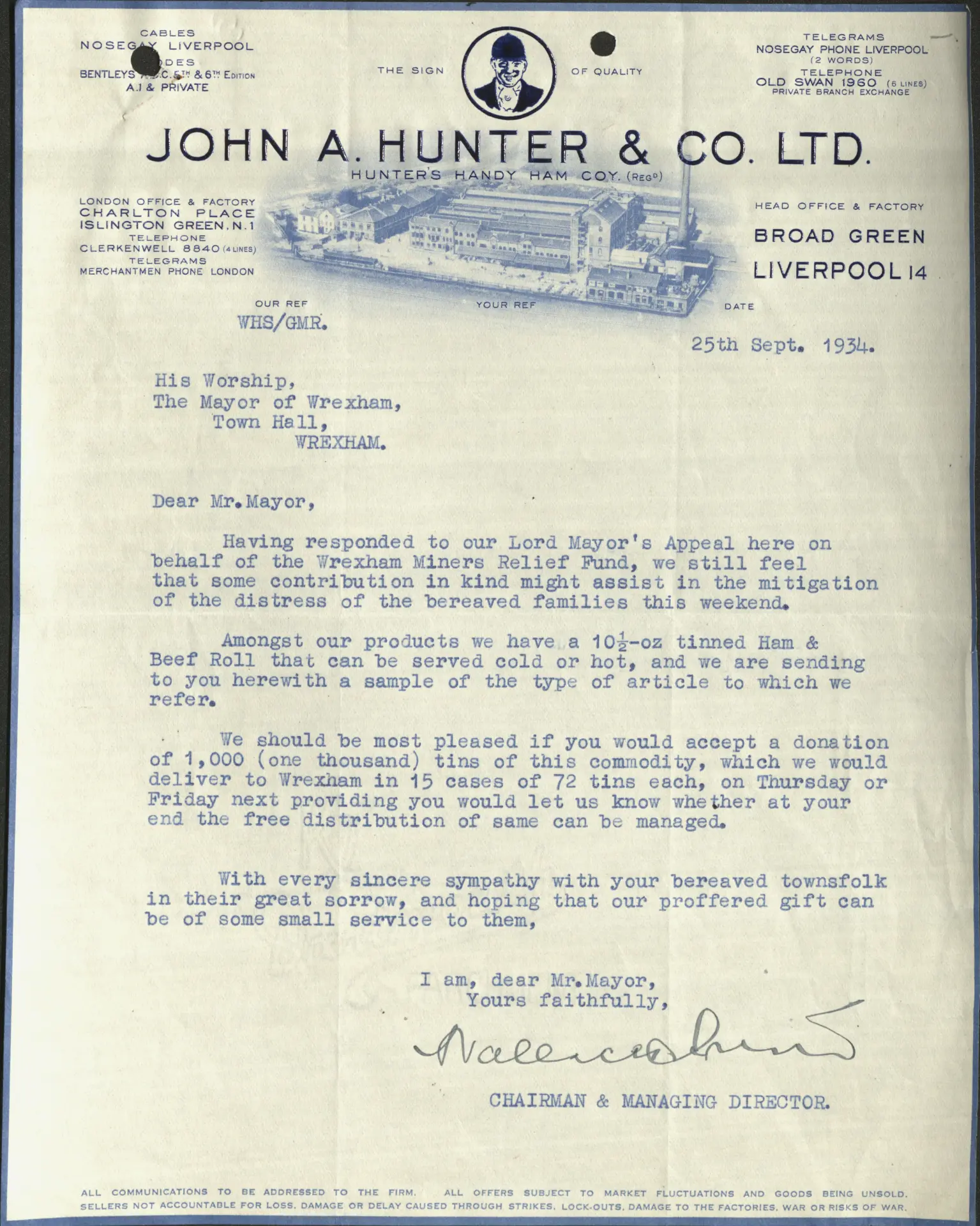 A letter accompanying of the donation of 1,000 tins of ham. (Credit: North East Wales Archives; Click to enlarge)
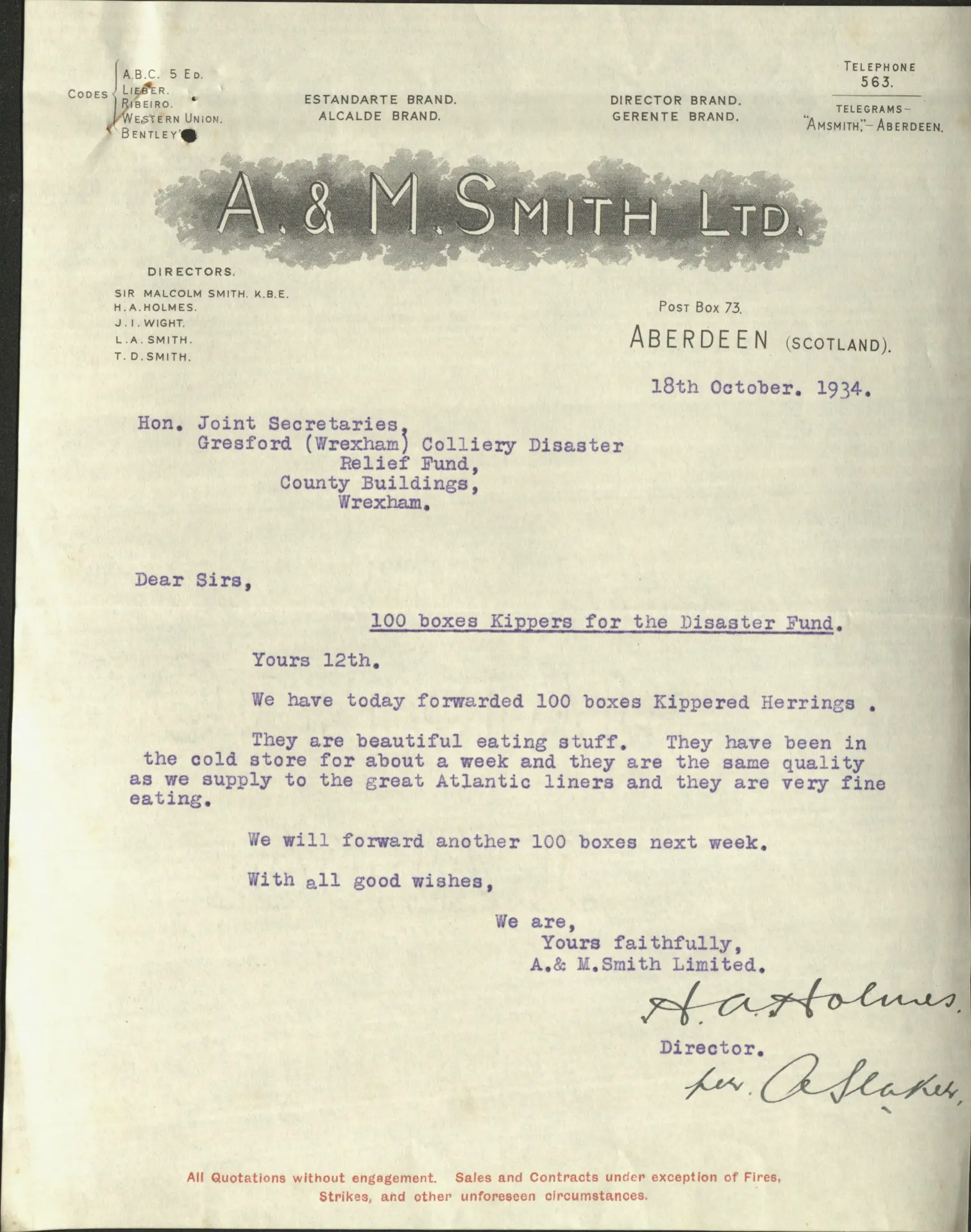 A letter accompanying of the donation of 100 boxes of kippers. (Credit: North East Wales Archives; Click to enlarge)
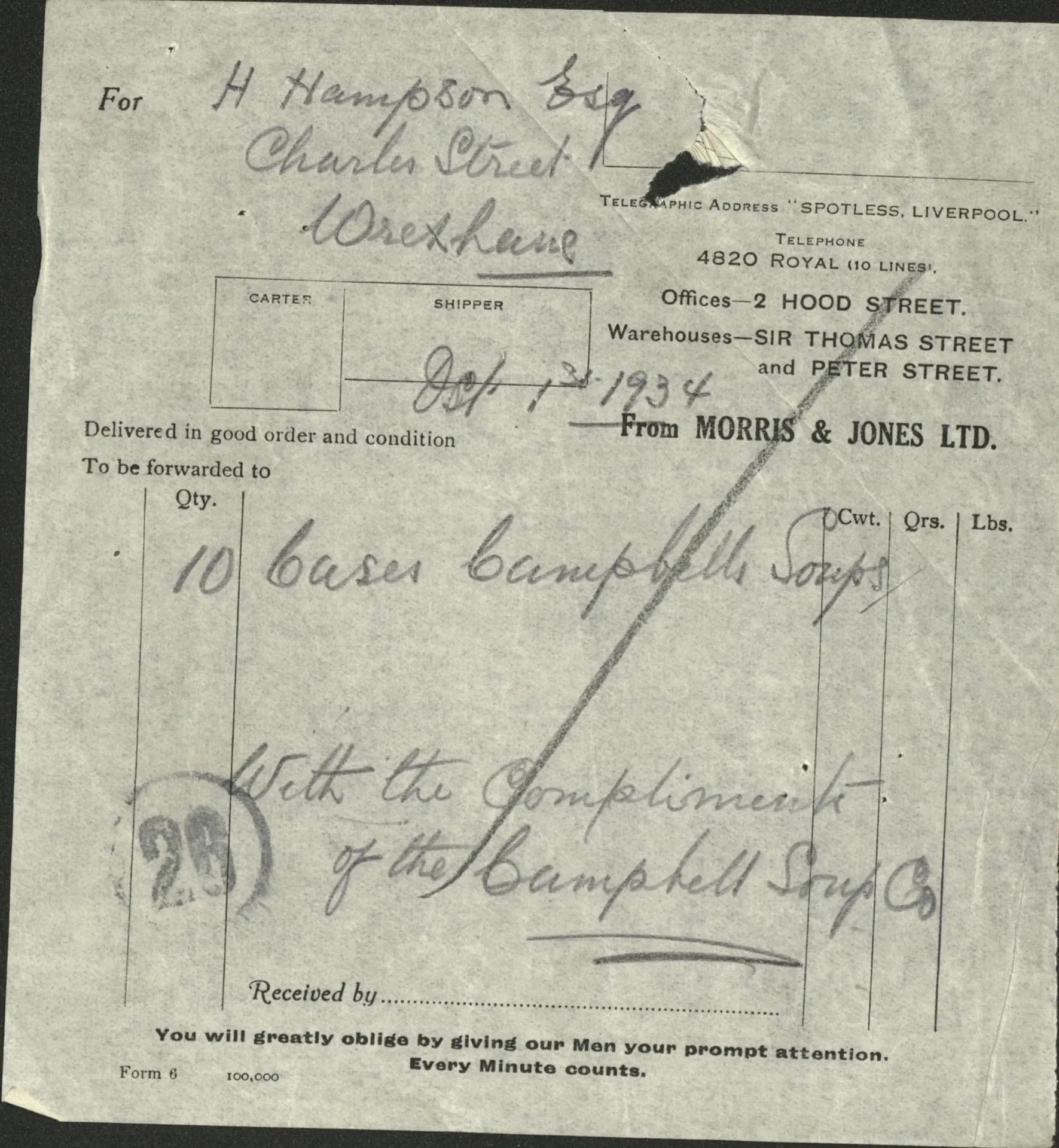 A letter accompanying of the donation of tins of soup from the Campbell. (Credit: North East Wales Archives; Click to enlarge)
Read Transcript
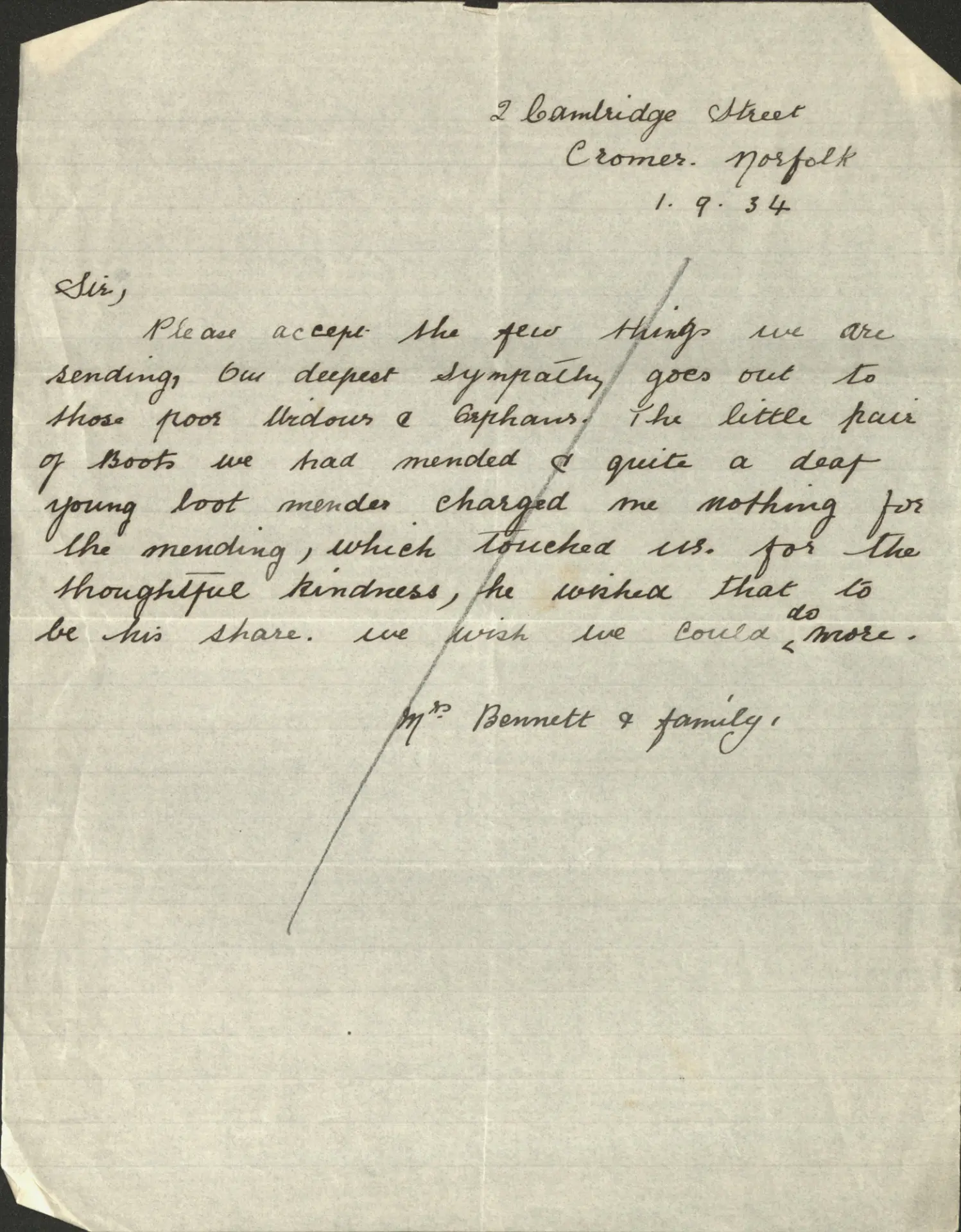 A letter accompanying mended boots donated to the fund. (Credit: North East Wales Archives; Click to enlarge)
Read Transcript
Please accept the few things we are sending, our deepest sympathy goes out to those poor widows and orphans. The little pair of boots we had mended and quite a deaf young boot mender charger me nothing for the mending, which touched us. For the thoughtful kindness, he wishes that to be his share. We wish we could do more."
Support came from far beyond the local area. A Belgian refugee remembered the kindness shown to him in 1915 and sent money. The Natal Cambrian Society sent donations all the way from South Africa.
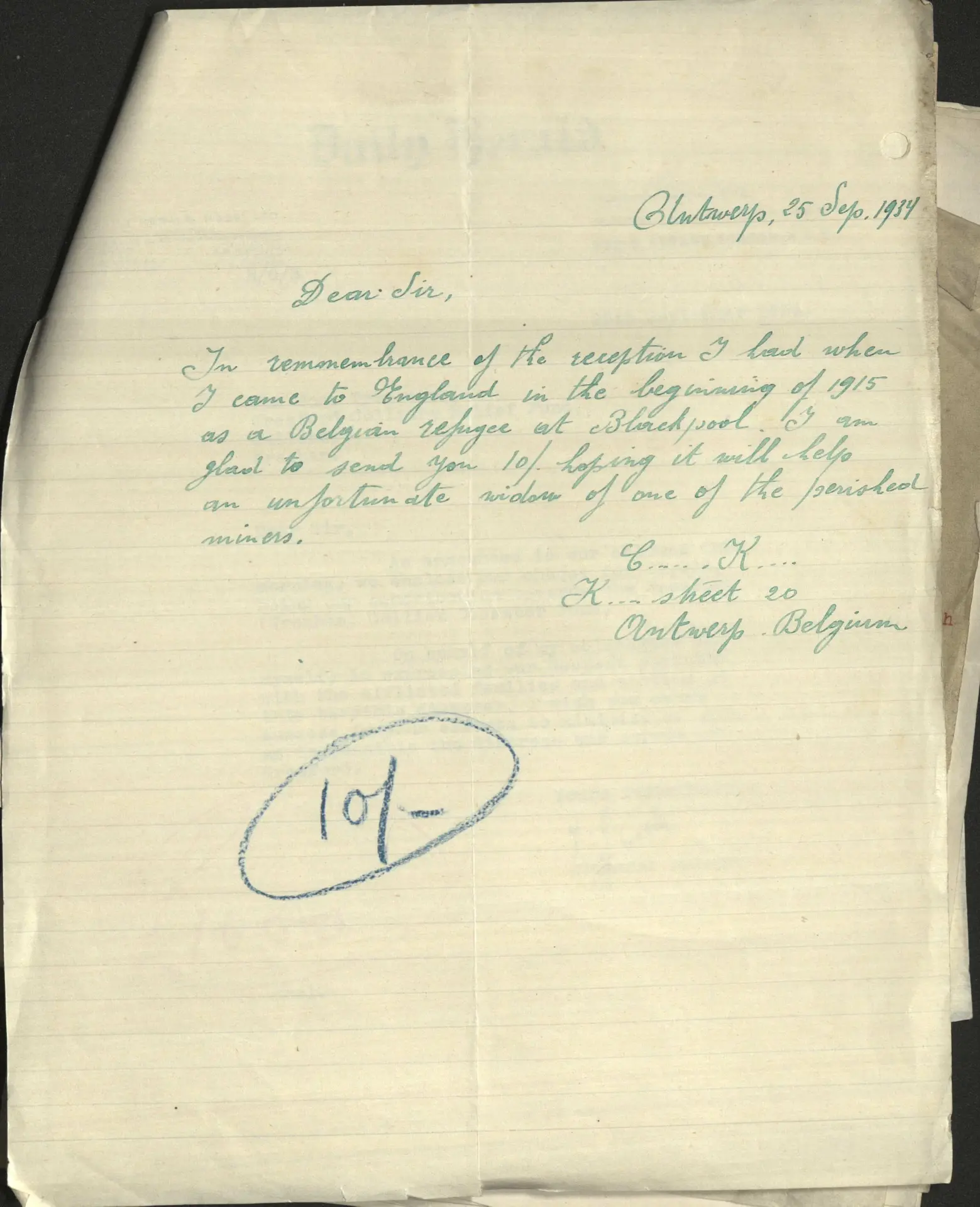 Donation from a former Belgian refugee. (Credit: North East Wales Archives; Click to enlarge)
Read Transcript
In remembrance of the reception I has when I came to England in the beginning of 1915 as a Belgian refugee at Blackpool. I am glad to send you 10/ hoping it will help an unfortunate widow of one of the perished miners”
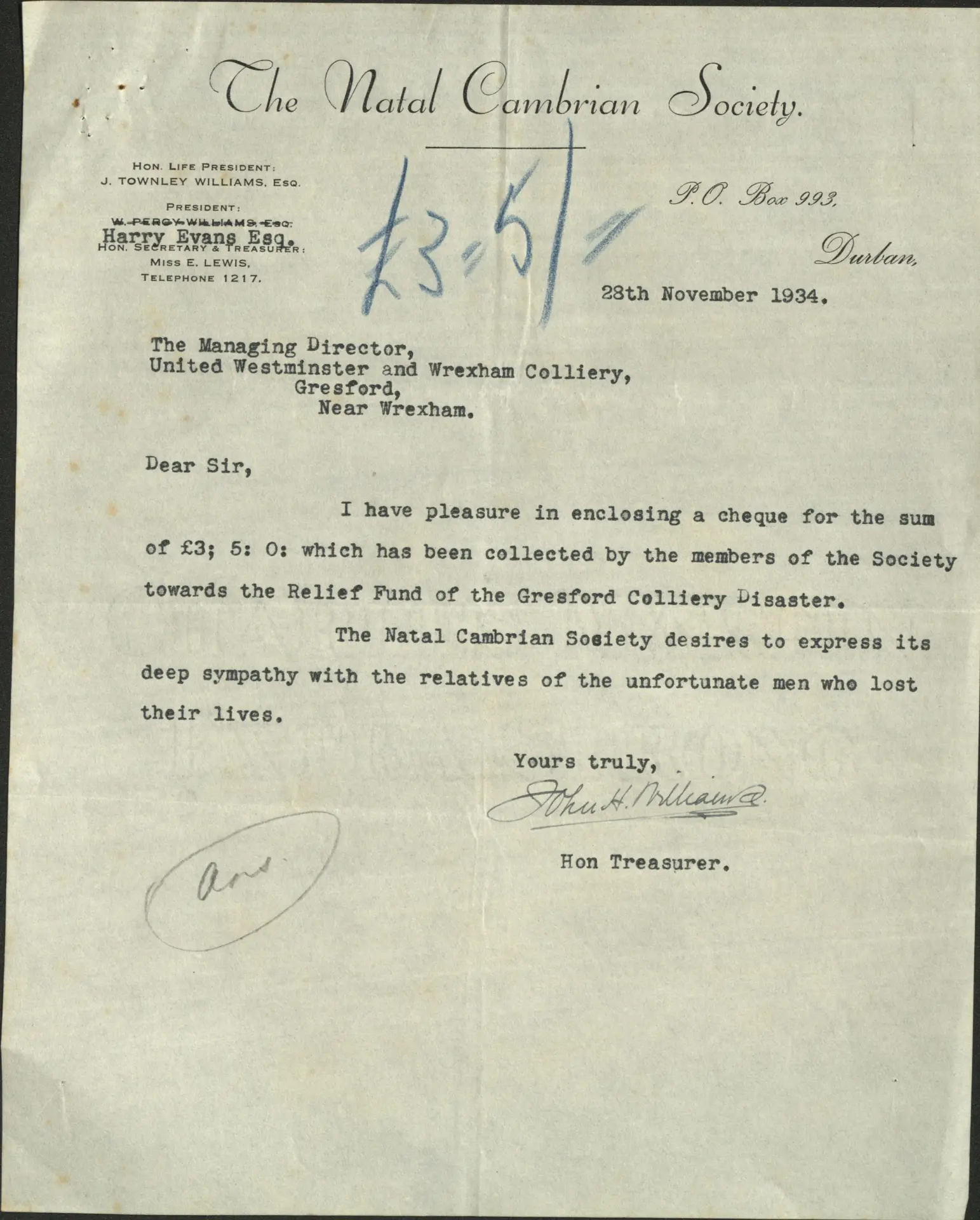 Donation from the Natal Cambrian Society. (Credit: North East Wales Archives; Click to enlarge)
The Inquiry
On the 25th of October 1934 a public inquiry was convened to establish what had caused the disaster and who if anyone was to blame. Conscious that they might face prosecution for the 266 deaths, Gresford's owners assembled a formidable legal team led by the Barrister Hartley Shawcross who argued the disaster was a freak accident which could not have been predicted. Representing the miners was Labour politician Sir Stafford Cripps who contended that negligence and lack of safety measures, including adequate ventilation contributed to the death toll. Anger in the local community boiled over and led to mine officials, including the pit manager: William Bonsall being booed from the public gallery.
"This estimate [100 dead] was made in good faith, and in honest belief that it was accurate"
Hand-drawn maps found by the Wrexham Miner’s Project show the complex layout of the mine. These documents illustrate the labyrinth of the Dennis section where gas accumulated and allowed the explosion to propagate with devastating force.
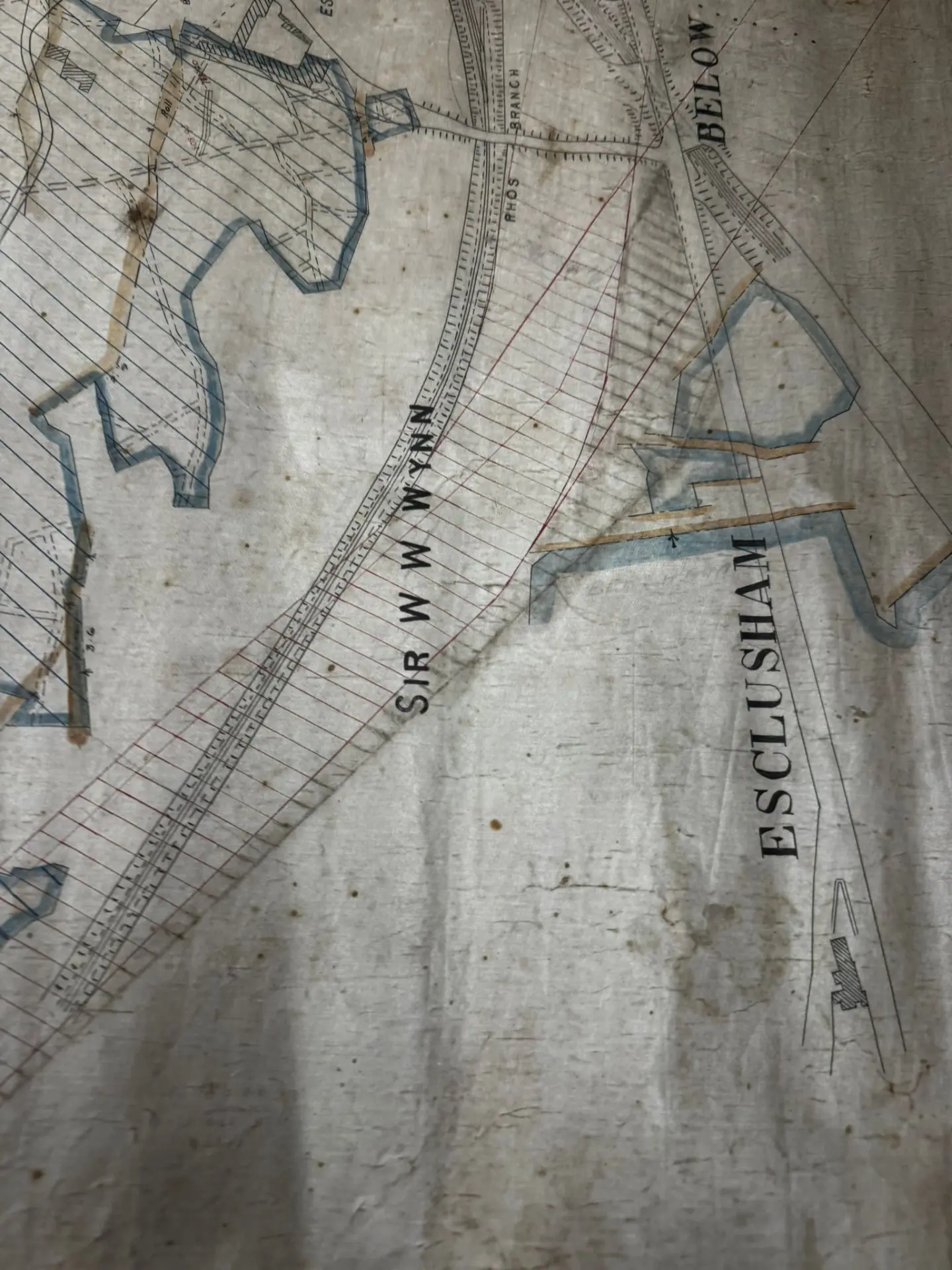 A hand-drawn map of the mine workings. (Credit: Wrexham Miner’s Project; Click to enlarge)
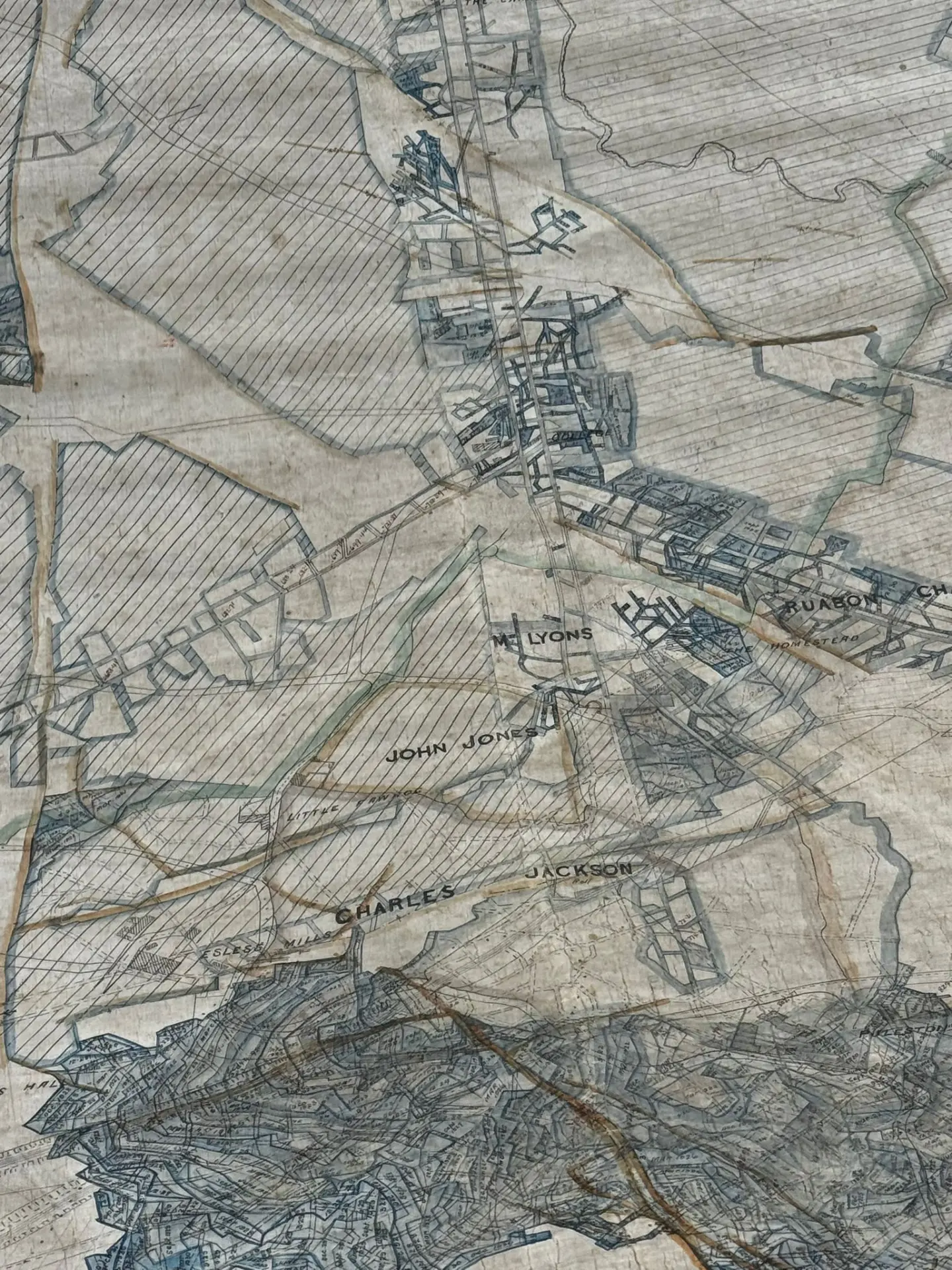 Detail of the Dennis section where the explosion originated. (Credit: Wrexham Miner’s Project; Click to enlarge)
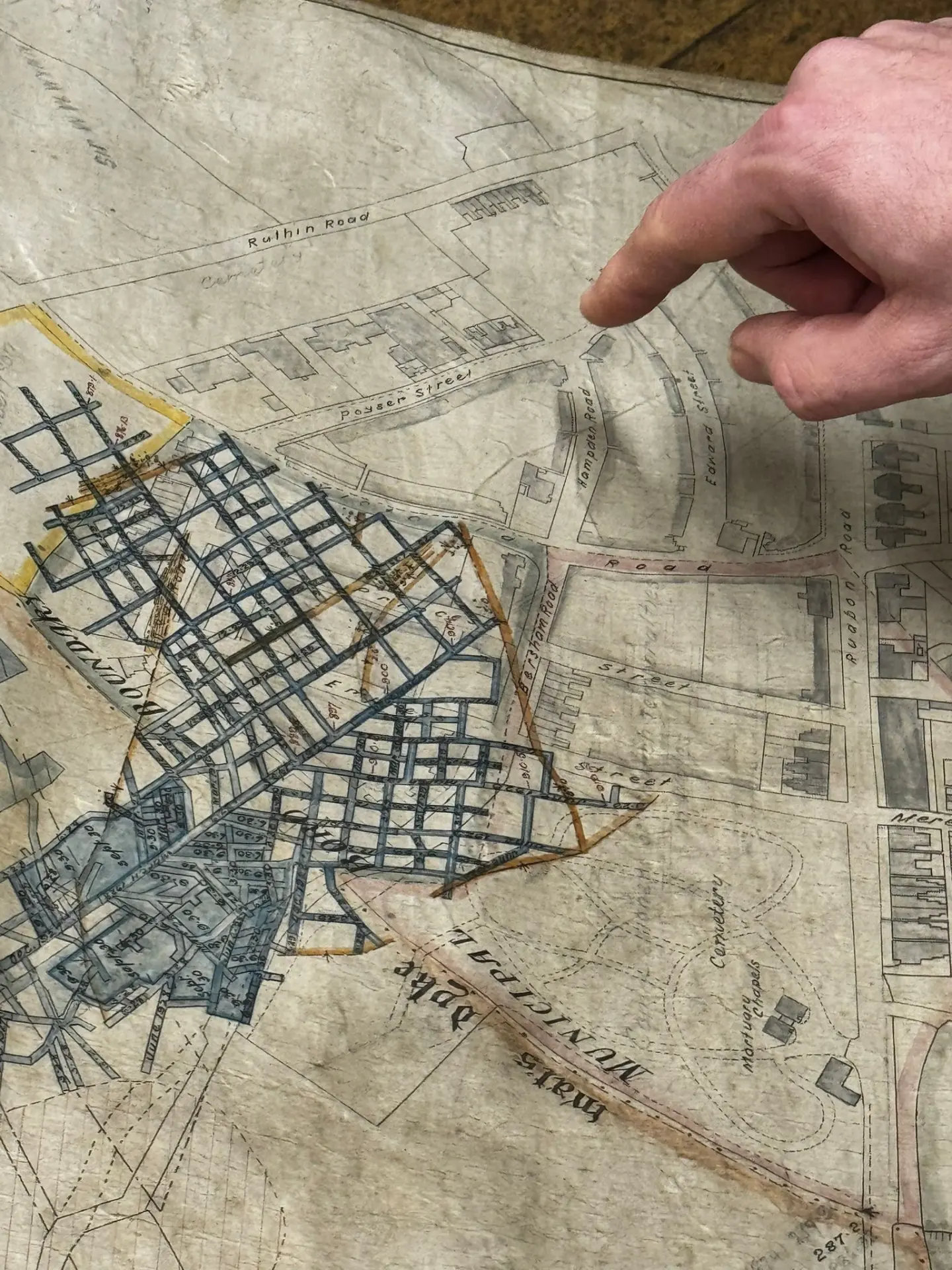 Further detailed mapping of the colliery workings. (Credit: Wrexham Miner’s Project; Click to enlarge)
Ultimately the inquiry reached few firm conclusions, and did not satisfy the survivors or victims' families. Some breaches of safety regulations, including lack of adequate ventilation were proven, but no single cause of the explosion was established. The generally accepted theory is that a natural gas explosion ignited deposits of coal dust. The mine owners faced few legal consequences. In 1937 a private prosecution brought in Wrexham's sessions court resulted in Bonsall being convicted of false record keeping, after it was established he had falsified ventilation records. His £140 fine with £350 legal costs represents the only legal penalty suffered by Gresford's management for the disaster.
"The impact of the Gresford Disaster—and the injustice and cover-ups that followed—still rings painfully true today. The strain placed on mothers, fathers, brothers, sisters, wives, and children was immense, made worse by the lack of compassion shown by the pit owners. Wives without children were forced out of their homes, wages were stopped at the moment of the explosion, and the unopened wage packets of the victims were still in their pockets. These acts deepened the grief of families already facing unimaginable loss.
The Gresford Disaster of 1934 left a scar on Wrexham that has never fully healed. On that tragic night, entire streets fell silent in shock and disbelief. Families waited at their doors through the long hours of darkness, praying for news that never came. The loss was not only personal—it was collective, felt by a community whose life, identity, and hope were inseparable from the mine and the men who worked within it.
Today, the Wrexham Miners Project carries the solemn responsibility of keeping these memories alive. Its mission to preserve the voices, stories, and heritage of Wrexham’s mining past ensures that the men of Gresford—and the strength of the community that bore their loss—are never forgotten. Through education, remembrance, and the safeguarding of our shared history, the project stands as a tribute to the courage of those who were lost and the resilience of those who survived.
The Gresford Disaster is not only a moment of tragedy—it is a reminder of the solidarity, dignity, and unbreakable spirit that define the people of Wrexham. The Wrexham Miners Project exists to ensure these memories continue to guide, teach, and inspire future generations."
Legacy
Gresford Colliery was reopened in stages and coal extraction began again in 1936. The mine never again reached the scale of production it had pre disaster, although demand brought on by the Second World War meant that by 1945 it employed 1743 men, still far short of the 2200 in 1934. The Dennis district where 253 are entombed remains sealed. In 1973 lack of profitability and exhaustion of the coal seam led to Gresford's closure.
Today the memory of Gresford Colliery is preserved by the The Friends of the Gresford Colliery Disaster Memorial, The North Wales Miner's Association Trust, and The Wrexham Miner's Rescue Project. Together they aim to honour the brave men who died in the disaster and those who survived by educating future generations about their story.
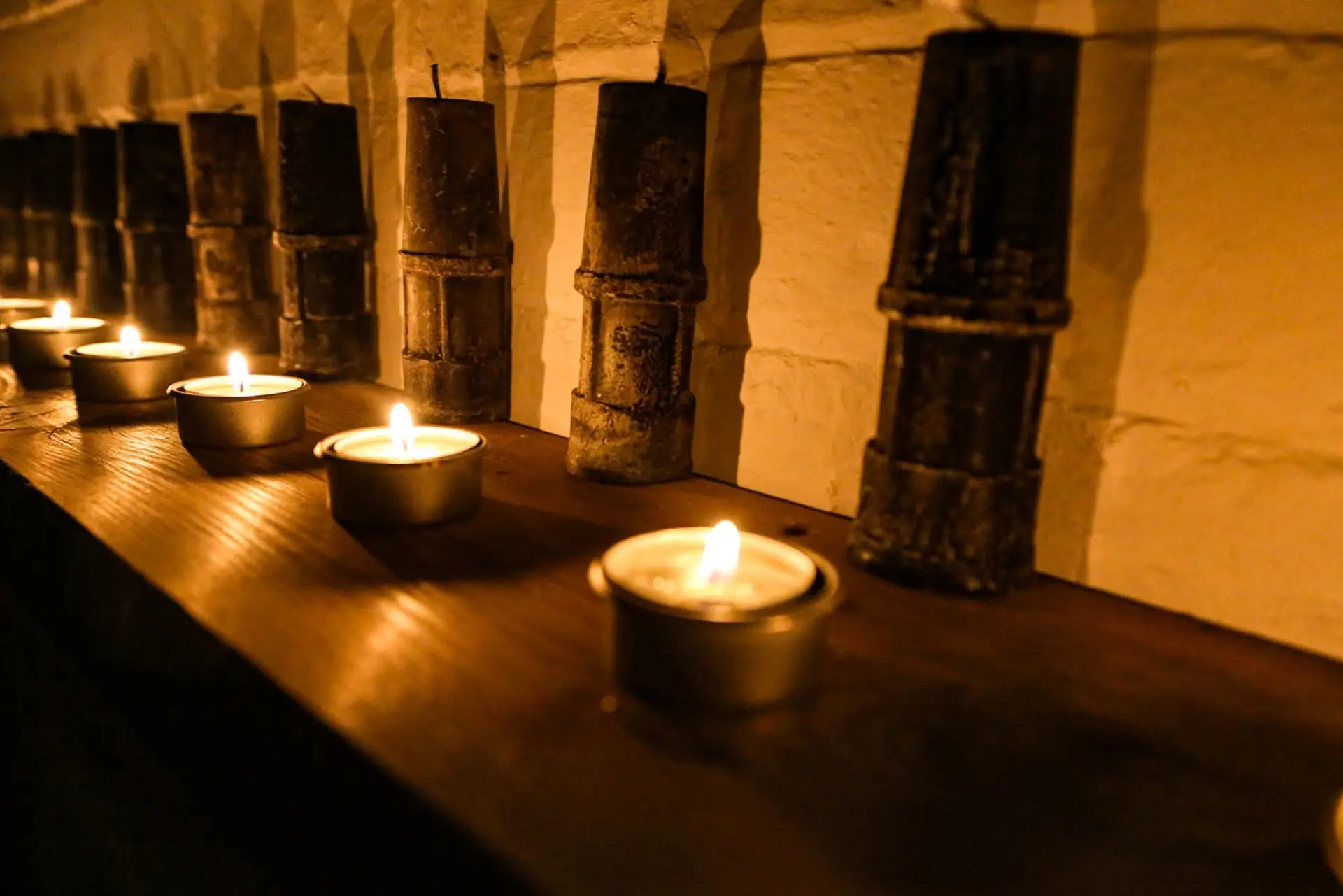 The tribute created by WMP for the 90th anniversary. (Credit: Wrexham Miner’s Project; Click to enlarge)
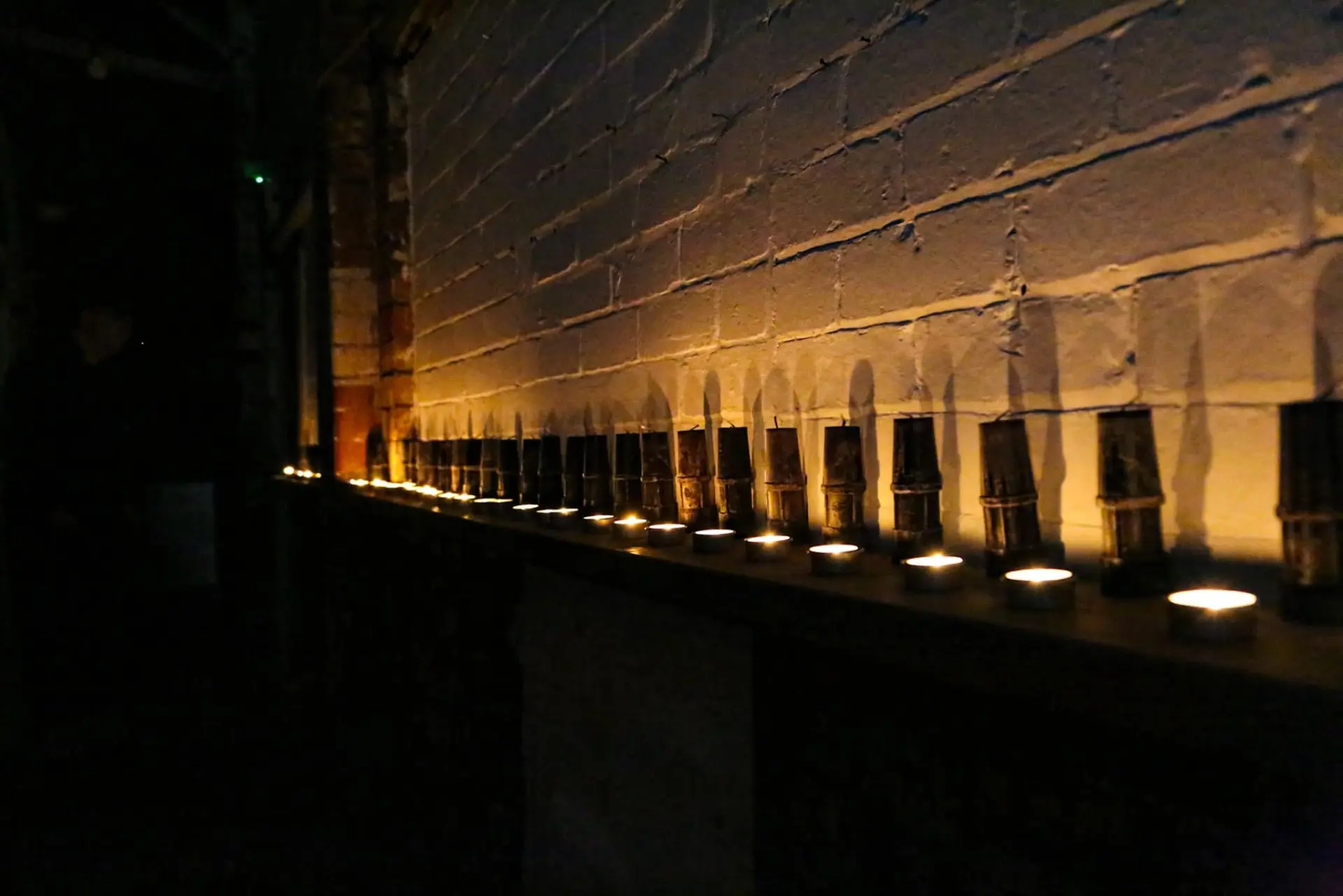 Further details of the 90th anniversary commemoration. (Credit: Wrexham Miner’s Project; Click to enlarge)
Visitors can view these archives at the centre which is housed in the building where the rescue teams once trained. It stands as a living monument to the victims and the families who fought for justice. The Wrexham Miners Project run tours for schools and community groups, sharing the history of the disaster and it's legacy. North East Wales Archives hold a substantial amount of documents on the disaster and the impact on the community. The National Archives have curated extensive documents and held a Gresford Community day at Wrexham Library for the 91st anniversary of the disaster.
Since 2021, Wrexham AFC football shirts have had '1934' embroidered on the reverse in memory of the disaster.
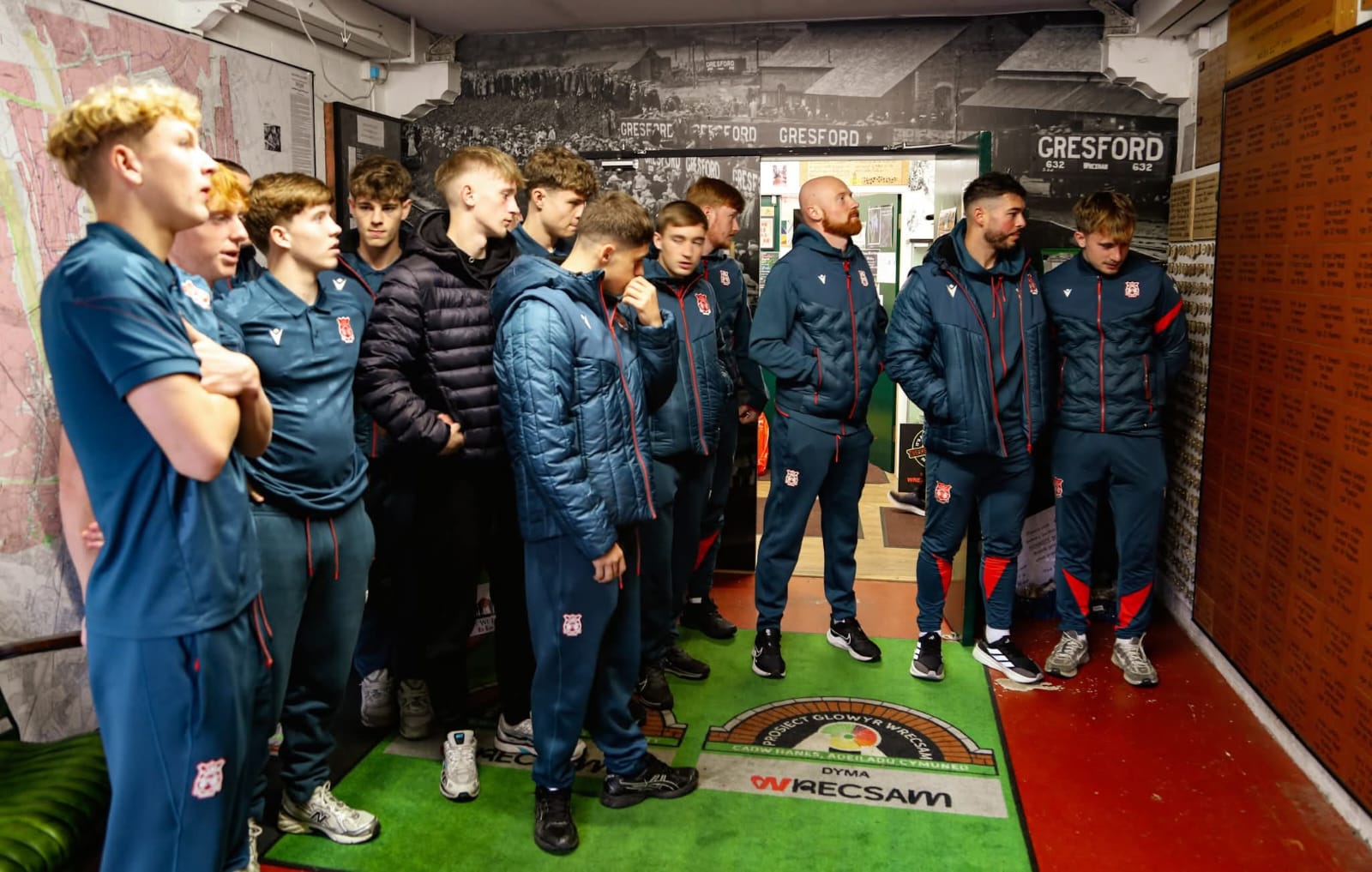 Wrexham football team academy receiving a historical tour of the Wrexham Miners Project (Credit: Wrexham Miners Project; Click to enlarge)
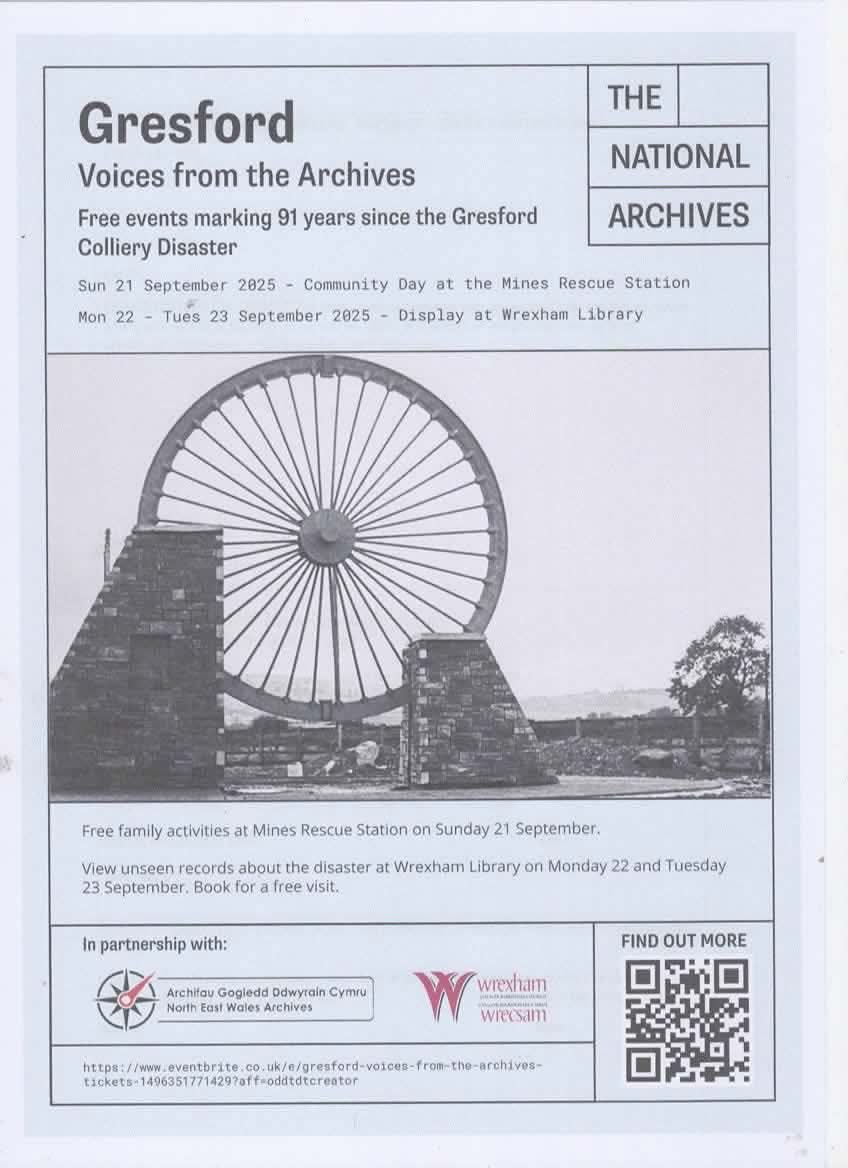 A flyer for The National Archives' Gresford Community Day at Wrexham Library for the 91st anniversary of the disaster. (Credit: National Archives; Click to enlarge)
Ruby's Story
Ruby McBurney was just three years old when her father died in the mine. William Crump was 36 when he entered the Dennis section. His death left his wife Mary with four young children and a mere £1.76 to survive.
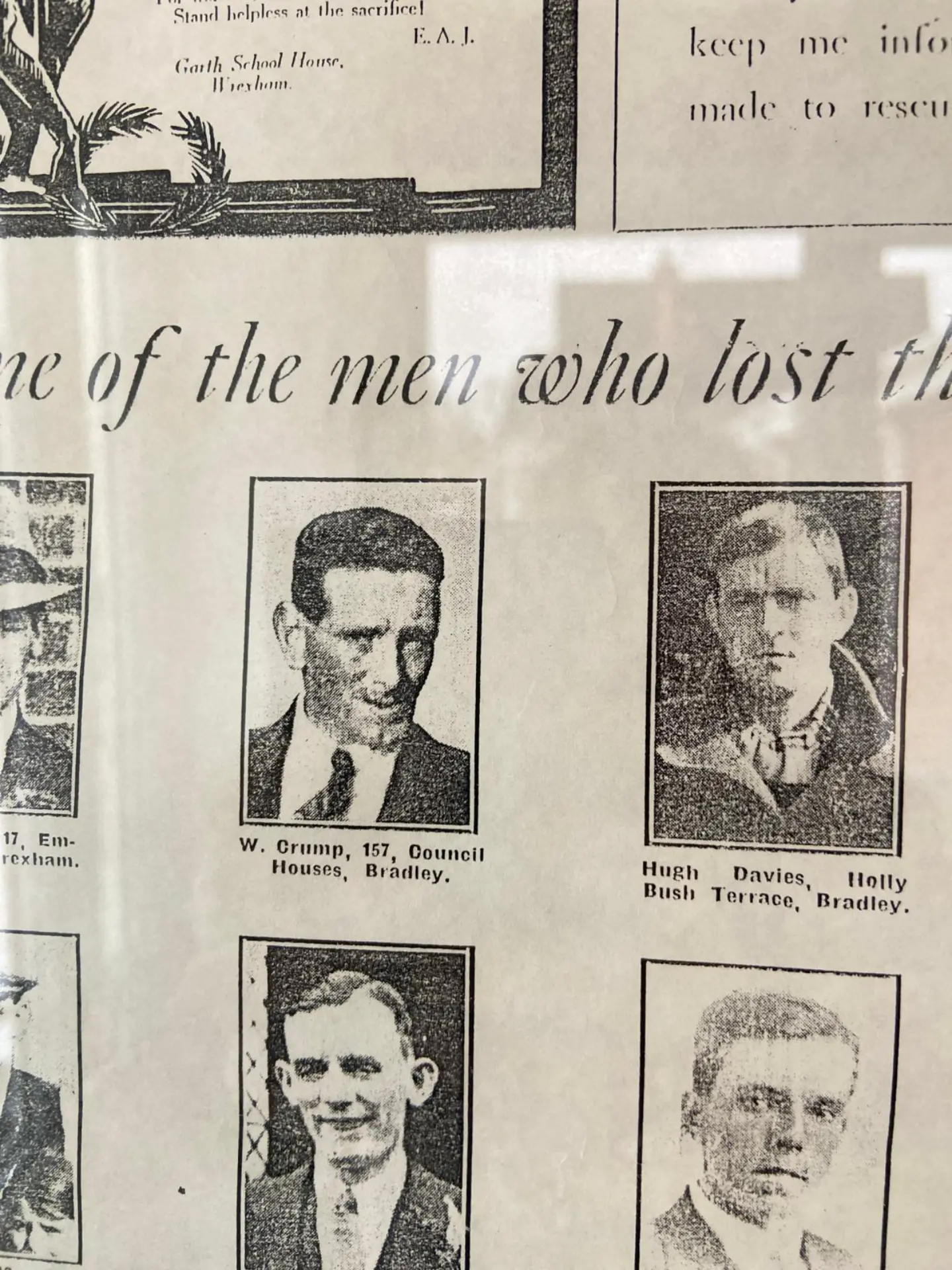 William Crump, Ruby’s father, who was lost in the disaster when Ruby was a toddler. (Credit: Ruby’s family; Click to enlarge)
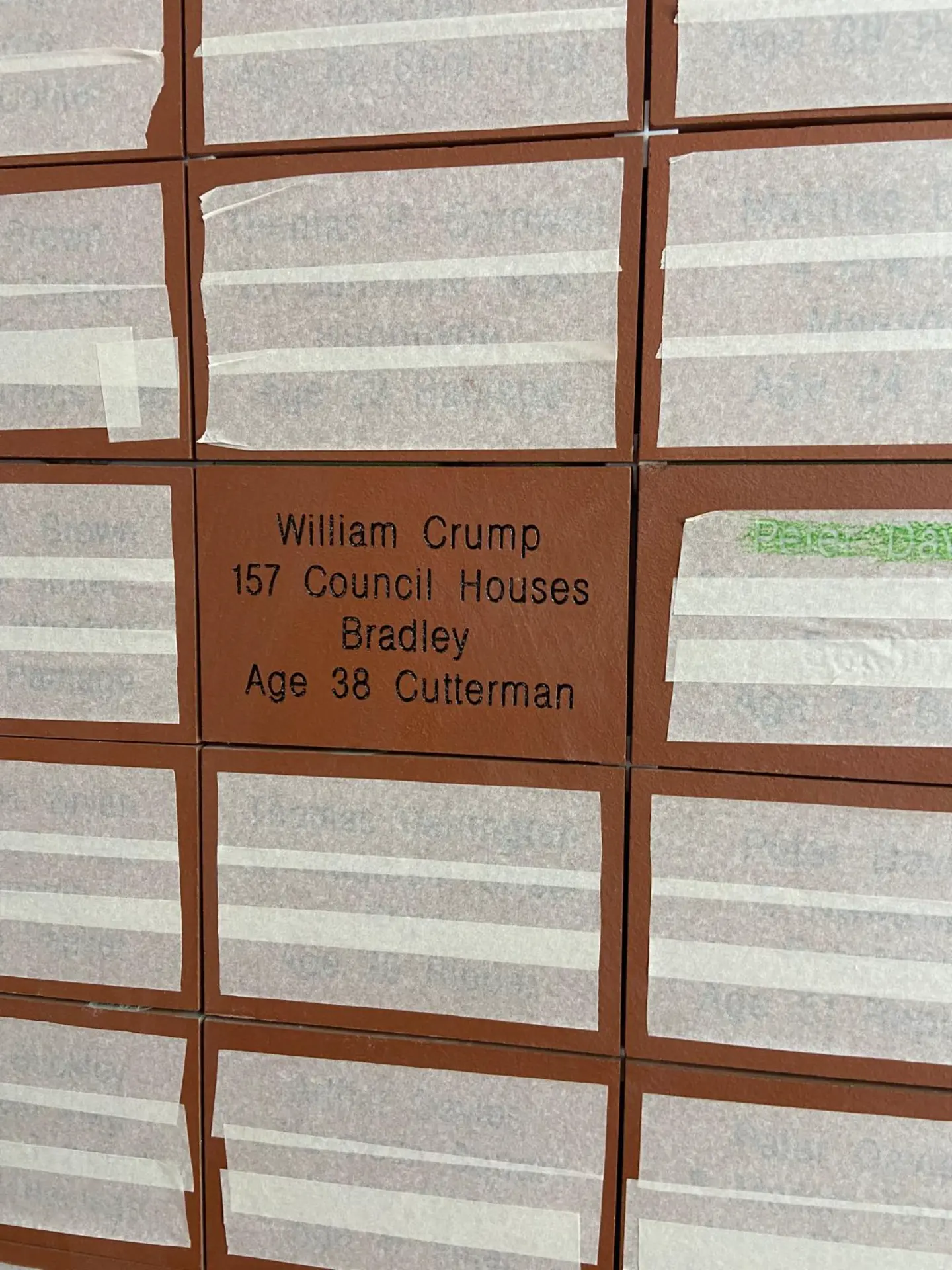 The name 'William Crump' inscribed on the memorial wall at the Wrexham Miner's Project. (Credit: Ruby’s family; Click to enlarge)
Her childhood was defined by loss. Her mother died eight years after the explosion and relatives fostered Ruby and her separated siblings. Despite this fractured start, Ruby forged a life of profound service. She trained as a nurse and spent decades working in the Special Care Baby Unit at Wrexham Maelor Hospital where she cared for the community's most vulnerable new lives.
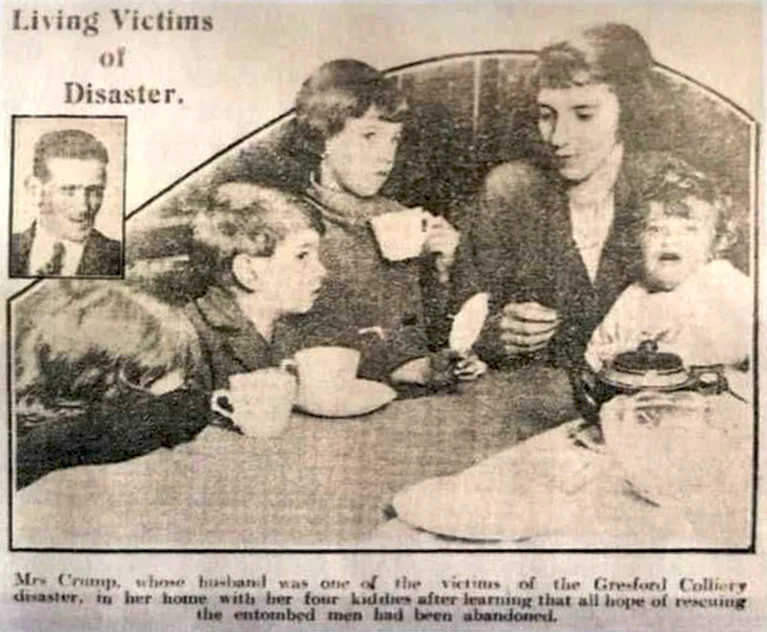 A contemporary press photograph showing Ruby (centre), her siblings, and her mother in the aftermath of the disaster. (Credit: Ruby’s family; Click to enlarge)
Locals called her "The Warrior" for her fierce advocacy. She helped found the Friends of Gresford Colliery Disaster Memorial to ensure the men were not forgotten. She campaigned tirelessly to have the names of all 266 victims permanently inscribed on the memorial at Pandy.
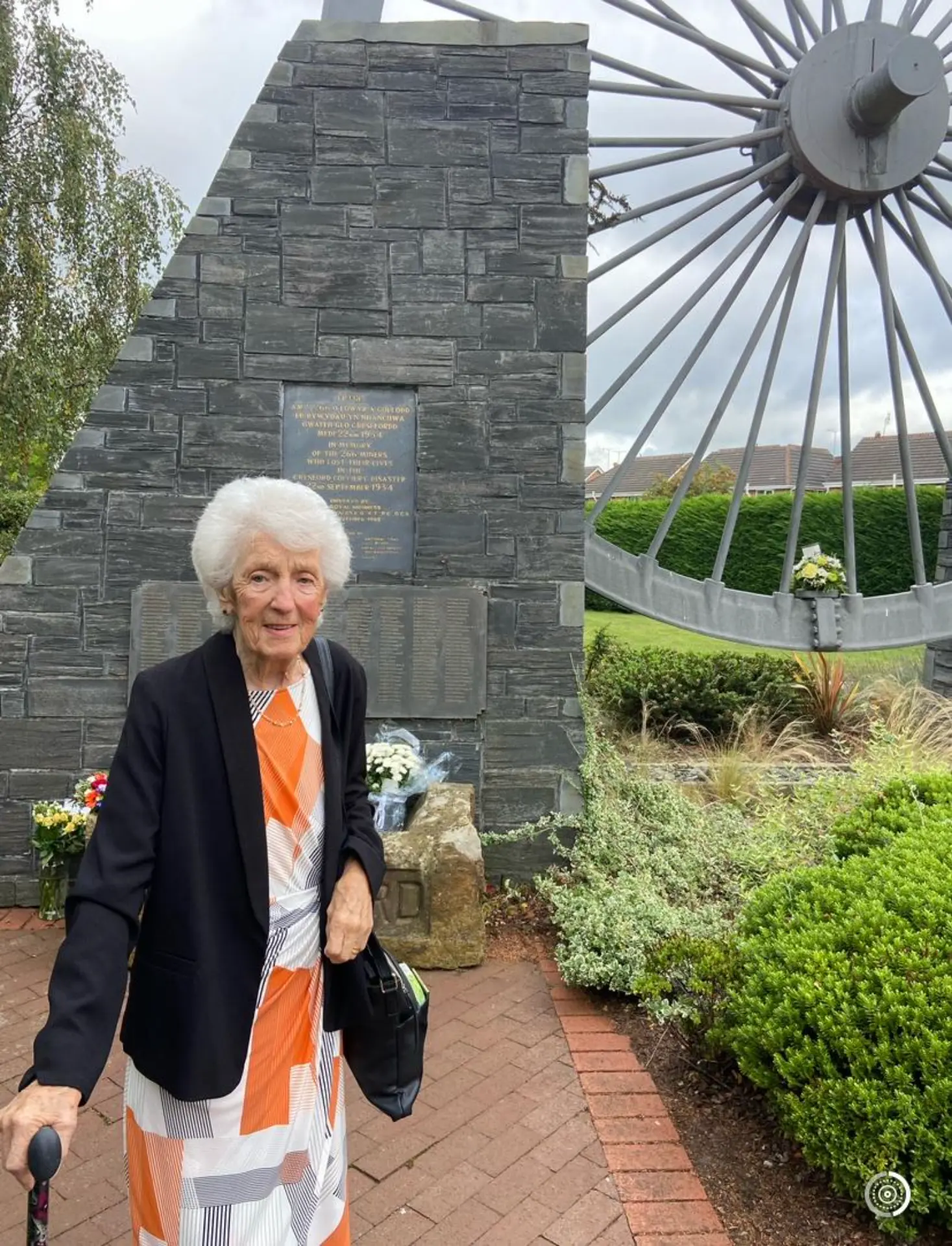 Ruby at the Gresford Memorial in later life. (Credit: Ruby’s family; Click to enlarge)
Ruby met The Prince of Wales at the memorial site in 2024 to share her story. She passed away in October 2025. Her work ensured the community carved the names of her father and his comrades in stone for eternity.